Anthropic's draft federal AI safety bill: court-ordered blocks only above a 50-death or USD 1 billion risk
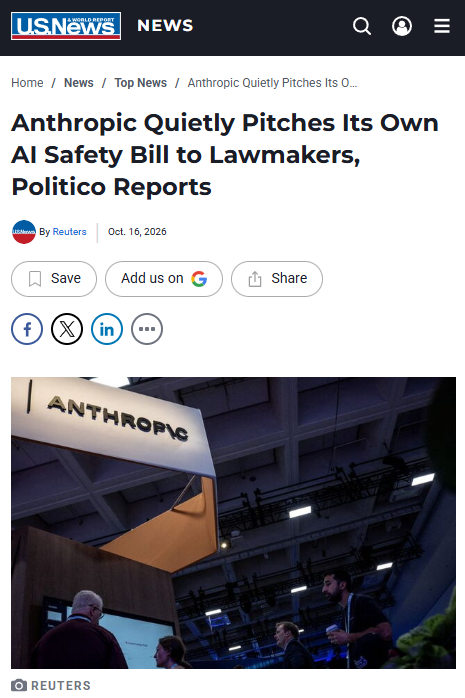
A draft US bill from Anthropic, published by Politico, would let the Commerce Department ask a federal court to block a model only for an imminent catastrophic risk, and would preempt some state laws. We explain the reported mechanism, the criticism, Anthropic's planned rewrite, and what is still unknown.
In short
On 16 October 2026, Politico published a draft US federal AI safety bill that Anthropic had shared with a small number of congressional offices; Anthropic confirmed that the draft is its own. The draft would let the Commerce Department ask a federal court to block a model's release only when independent evaluators find a foreseeable, imminent risk of more than 50 deaths or serious injuries, or more than USD 1 billion in damage. It would also preempt some state AI laws. After criticism, Anthropic said on 18 October that it will rewrite the preemption language and may revisit the thresholds. The full bill text has not been published, so this summary relies on press reports.
How it works
The draft, as reported, has three parts:
- Registered evaluators. Independent evaluators register with the Commerce Department and test frontier models for catastrophic potential. Labs may pay them, but payment must not depend on the result.
- A 72-hour report. If an evaluator decides that a model poses a foreseeable, imminent catastrophic risk, it must notify Commerce within 72 hours.
- A court decides. Commerce may then petition a federal court in Washington, D.C. to block the model's release or use. No agency could halt a model on its own authority.
The risk must come from one of three sources: a biological weapon, a model escaping its developer's control, or a cyberattack.
Analogy: the design resembles a fire inspector who cannot close a building alone, but must ask a judge first. The debate is about how bad the danger must be before the inspector may ask, and who pays and checks the inspector.
Under the hood
Where the numbers come from. The thresholds (more than 50 people, more than USD 1 billion) follow the definition of "catastrophic risk" in California's SB 53. California state senator Scott Wiener, the author of SB 53, said that the draft misuses this definition to weaken emergency shutdown powers and sets no minimum standards.
Comparison of the main design choices (as reported).
| Question | Anthropic draft (reported) | What critics point to |
|---|---|---|
| Who can stop a model? | Only a federal court, on a Commerce petition | State courts and agencies would lose that power (Encode) |
| Who checks the evaluators? | Registration with Commerce; no licensing standard reported | Without licensing, auditors may compete on the cheapest, least demanding checks (LawAI) |
| Which models are covered? | Frontier models, with a lower training-size threshold than the FRONTIER Act or California law | Would cover many startups (David Sacks) |
| State laws | Preempts some state rules on disclosure, third-party evaluation and incident reporting; child-safety and civil-rights laws excluded | Weakens California's SB 53 (Senator Scott Wiener) |
The exact training-compute threshold, penalties and the legal standard that the court would apply were not reported.
Anthropic's response. Anthony Cimino, Anthropic's federal affairs lead, wrote on 18 October that the preemption wording was "not precise enough" and will be changed to match the company's Advanced AI Framework. He also said that the California-derived thresholds should probably be re-evaluated for a national standard, and that the blocking bar must not be so high that it is never used. Anthropic says it will publish further proposals on independent evaluators.
Context. The draft is one of several federal proposals. Shakeel Hashim (Transformer) called it weaker than the bipartisan FRONTIER Act, because it sets no evaluator standards or licensing and makes models harder to block. As of 22 October 2026, we found no report that a member of Congress has introduced the draft as a bill.
What is unknown. The full text; any sponsor; the coverage threshold in numbers; how the "payment not contingent on results" rule would be enforced; and whether the revised version will keep the 50-person and USD 1 billion bar.
Disclosure. This article was drafted by an AI research assistant built on Anthropic's Claude models. The editor reviews every article before publication. We report Anthropic's statements and the criticism with equal weight and with sources.
Try it yourself
There is no code to run. If you want to check the claims yourself:
Step 1. Read the definition of "catastrophic risk" in California SB 53 (Transparency in Frontier Artificial Intelligence Act) on the California Legislative Information site, and compare it with the thresholds above.
Step 2. Look up the FRONTIER Act on congress.gov and compare its halt mechanism with the one reported here. Note which body decides, which standard applies, and whether evaluators need a license.
Step 3. Watch for the revised draft that Anthropic has announced. The key questions are whether the preemption scope narrows and whether the blocking threshold changes.
Sources
- Anthropic pitches AI safety bill that may block a model if 50+ people could be killed (TechCrunch, 20 Oct 2026)
- Anthropic to rewrite part of its leaked AI bill after safety backlash (The Next Web, 20 Oct 2026)
- Anthropic quietly pitches its own AI safety bill to lawmakers, Politico reports (US News/Reuters, 16 Oct 2026)
What should happen next with this?
One click per article, no account needed. “Go deeper” feeds the research queue.