ARTEX: the FBI and Amazon describe intrusions run by LLM agents, from stolen AI keys to under three hours to privileged access
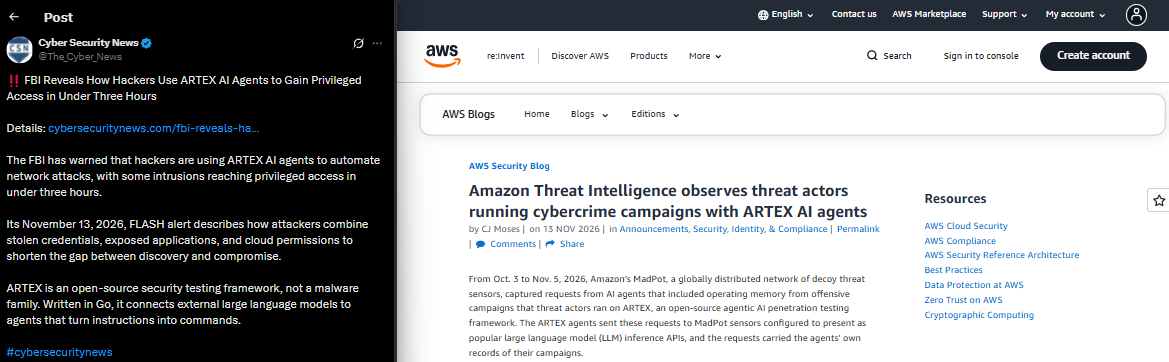
An FBI FLASH alert and an Amazon threat report (both 13 Nov 2026) document real intrusions driven by ARTEX, an open-source multi-agent penetration-testing framework. We explain its planner, worker, verifier and memory design, the two campaigns Amazon recorded (theft of LLM API keys, deepfakes against identity checks), the numbers and their confidence, and what defenders can check, with a recorded secret-scanning workflow.
In short
On 13 November 2026 the FBI published a FLASH alert on ARTEX, an open-source framework in which LLM agents carry out penetration tests on their own, from reconnaissance to data theft. Criminal and state-linked groups have used it since at least August; in some intrusions the agents reached privileged access in under three hours. On the same day Amazon published what its decoy sensors recorded between 3 October and 5 November: people set the goals, and agents did the work, including a campaign that steals API keys for AI models to pay for more agent runs. Nothing in the reports is a new attack technique. The entry points are default passwords, unauthenticated admin pages and secrets in public files. What changed is the speed and the breadth with which these old weaknesses are found.
How it works
ARTEX is a program written in Go that contains no model of its own. The operator connects it to an external LLM service and gives it a standing instruction: the objective, which targets are allowed, and rules of operation. From there the agents translate the goal into commands, run them, read the output and decide the next step.
Amazon describes four agent roles: a planner that splits the goal into tasks, workers that run tools, a verification agent that checks claimed results, and a compression agent that shortens the history so that long operations fit into the model's context. All of them read from and write to a shared, persistent knowledge graph, so one agent continues where another stopped. In one campaign at least four agent sessions ran in parallel and handed tasks to each other.
Analogy: a night shift of interns with a shared notebook. None of them is brilliant, but they try every door of every building, write down which one was open, and never get tired.
Under the hood
Timeline (FBI).
| Date | Event |
|---|---|
| July 2026 | First release on GitHub; 1,500–2,000 stars within 10 weeks |
| Since August 2026 | Use in real intrusions |
| 8 October | The developer removes the repository after abuse reports. Forks, mirrors and a commercial "ARTEX PRO" remain |
| 7–30 October, 5 November | Reports by CrowdStrike, Zscaler, Microsoft, Akamai, Google, Censys, CERT-EU, Check Point |
| Early November | More than 1,600 ARTEX consoles reachable from the internet |
| 13 November | FBI FLASH-20261113-001 and Amazon's report |
Models. ARTEX supports Anthropic Claude, OpenAI GPT, DeepSeek, GLM, Grok and Kimi. According to the FBI, attacker-controlled instances mostly use models of Chinese origin, especially the DeepSeek Flash family. This matters for defence: provider-side abuse detection helps only where the provider looks, and open-weight models can be run without any provider.
Reported impact (FBI). A campaign against a South Korean financial company exposed data of about 67,000 people. A supply-chain compromise through ConnectWise Cloud Backup reached more than 2,250 downstream tenants. In single intrusions the agents sent more than 500 requests for directory fuzzing, enumerated more than 110,000 Active Directory objects, and created 100 GB volumes to stage data.
How the agents get in. The FBI lists, among others: hardcoded admin passwords in JavaScript bundles, APIs without authentication, SSRF, SQL injection, template injection, unsigned SAML assertions, and stolen VPN configurations. After entry the alert lists well-known steps: web shells, Kerberoasting, DCSync, pass-the-ticket, tunnels such as Chisel. One detail shows the planning: the agents built an inventory of hosts without an endpoint sensor before moving on.
Amazon's campaign 1: stealing AI credentials. The agents searched the internet for exposed AI applications, extracted the provider keys stored in them, tested the keys and kept them in a pool. Targets were LLM gateways (One API, New API, LiteLLM and others) and AI app builders (Dify, FastGPT, Langflow, RAGFlow, Open WebUI, LobeChat, Ollama). The weaknesses:
- fresh installs that nobody had initialised, so the first visitor becomes the administrator,
- anonymous management endpoints and default admin credentials, including LiteLLM's default master key,
- known flaws CVE-2025-3248 (Langflow) and CVE-2026-28797 (RAGFlow),
- SSRF through "fetch this URL" features to the cloud metadata service,
- secrets in client-side JavaScript, source maps, debug routes and environment files.
Keys were also collected from GitHub, npm and PyPI packages, container image layers, notebooks and paste sites. The agents graded each credential: L1 a lead, L2 a confirmed working API call, L3 a measured value such as readable data or spendable balance. Keys that had been public for more than 30 days counted as low value. Stolen keys were entered into the framework's own model gateway, where they powered the next round of searching. The operation therefore pays for its own compute with the victims' accounts.
Amazon's campaign 2: deepfakes against identity checks. Agents tried to pass the identity verification of two cryptocurrency exchanges. They reverse-engineered one vendor's liveness protocol and built a real-time face animation pipeline on one consumer GPU at 11.5 frames per second. They also forged document photos with consistent camera metadata. The vendor's server-side check rejected the deepfake in every recorded attempt.
How sure are the sources? Amazon states moderate confidence that the agents ran on ARTEX and that the activity comes from several groups with a Chinese nexus (simplified Chinese prompts, time-zone settings, mainland targets excluded). Amazon saw the agents only through its decoy sensors and says it cannot verify the outcomes the agents reported to their operators. The FBI figures are compiled from vendor reports named in the alert.
What to look for (FBI).
- Bursts of activity compressed into minutes, and duplicate requests from overlapping sub-agents.
- Many failed logins where each attempt changes the previous one slightly.
- Sequential record lookups and unusually many records per session on partner or staff portals.
- Outbound calls from servers to LLM APIs, or to unknown LLM proxies and resellers; unexpected token spend.
- In Azure: deployment "dry runs" across many resource types, and test files written and deleted in storage within less than a second.
What to do. Both reports give the same answer: the basics. Inventory everything that faces the internet, including forgotten partner and legacy systems. Put AI gateways and inference endpoints under the same controls as other production systems. Remove default credentials. Scan repositories, images and front-end bundles for secrets and rotate what you find, assuming it has already been found by others. Rate-limit and alert on high-impact APIs. The alert also asks organisations that used ConnectWise Cloud Backup to review logs from 1 October.
Try it yourself
Terminal recording: scan a project for secrets before attackers do. The recording below uses the open-source scanner detect-secrets 1.5.0 (Yelp, Apache-2.0) on a small demo project with three planted placeholder secrets. It creates a baseline of known findings and then shows the pre-commit hook blocking a new key with exit code 1. All keys in the recording are invented or are AWS's documented example values. To repeat it:
python3 -m venv venv && ./venv/bin/pip install detect-secrets==1.5.0
detect-secrets scan --all-files > .secrets.baseline
detect-secrets-hook --baseline .secrets.baseline $(git ls-files)
A scanner finds formats it knows and high-entropy strings. It does not find a weak password that looks like a normal word, and it does not tell you whether a found key was already abused: rotate it anyway.
Two Python live snippets (standard library, synthetic data):
- Agent-like behaviour in an access log. 40 normal users plus one automated client that walks customer ids one by one and then tries 60 logins. Three simple features (peak requests per minute, share of id steps equal to +1, failed logins) separate them. Expected: the row
client-x 328 100% 60 REVIEWandokfor the others. Real agents add delays and proxies, so treat thresholds as a start, not as a detector. - Secrets in front-end files. Pattern rules find a password in a JavaScript bundle, an API key inside a source map and a default gateway key in an environment file (
findings: 3). The entropy lines show why entropy alone is not enough: the repetitive placeholder key scores 3.30 bits per character, about the same as an English phrase (3.27), while a random-looking key scores 5.00.
Terminal
Sources
What should happen next with this?
One click per article, no account needed. “Go deeper” feeds the research queue.