FlashProve: zero-knowledge proofs that a specific model produced an output, demonstrated on Llama 4 Maverick at about 72 times the serving cost
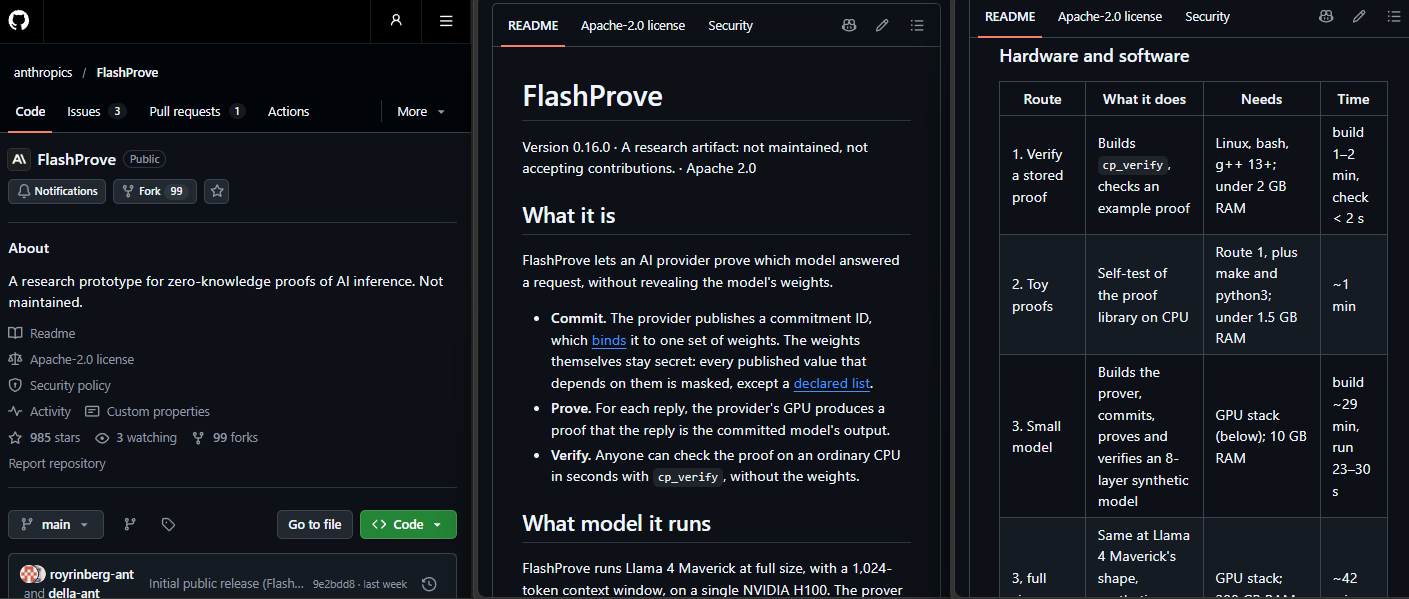
Anthropic and academic co-authors released FlashProve (Apache-2.0), a research prototype for provable inference: a provider commits to secret weights once and then proves, per 1,024-token request, that this model produced these tokens. On Llama 4 Maverick proofs are ~19 MB and verify in ~20 s on a CPU, but proving costs ~72x the GPU time of vLLM. We explain the idea, the numbers and the limits.
In short
On 2 November 2026 Anthropic's Frontier Red Team, with researchers from EPFL, MIT and others, published FlashProve, an open-source research prototype (Apache-2.0) for provable inference: a provider publishes a short commitment ("fingerprint") to a model's weights, and later sends, with each reply, a zero-knowledge proof that exactly this committed model produced exactly these output tokens for this prompt. The weights stay secret, and a client can check a proof on a normal CPU in about 20 seconds. The demonstration model is Llama 4 Maverick (400B MoE, 4-bit). Proving costs about 72 times the GPU time of normal serving, so this is a feasibility result, not a deployable service; no lab, including Anthropic, plans to use it yet.
How it works
The problem: when you call a model through an API, you cannot see which model answered. A provider could quietly serve a cheaper model, a quantized one, or a different model for benchmark runs. FlashProve turns "trust us" into a check that anyone can run.
- Offline: commit. The provider computes a commitment to the weights once (about 39 minutes on one H100 for Maverick) and publishes its ID through a channel clients trust. The commitment binds the provider to one set of weights but reveals nothing useful about them.
- Online: serve and prove. Requests run as usual. Afterwards, in batches, the prover produces a proof that the committed network, run as an exact integer computation with greedy decoding, outputs the claimed tokens. Requests are windows of 1,024 tokens.
- Verify. The client downloads the commitment (about 6.5 MB once) and one proof per request (about 19 MB), and runs the verifier. Answer:
YESorNO: <reason>.
Analogy from the authors' coverage: it works like DKIM signatures for e-mail, but for which model wrote this instead of which server sent this.
Under the hood
Proof system. A zkSNARK built by compiling an interactive oracle proof into a non-interactive proof with a hash function (BLAKE2b, modelled as a random oracle). The protocol uses code-based proximity tests with linear constraints and lookup arguments; arithmetic is over the 64-bit prime field p = 2^64 − 2^32 + 1. Because security rests only on hashing, the authors describe it as post-quantum secure.
Why this is possible at all. A transformer forward pass is mostly matrix multiplication plus a few non-linear functions. Checking a matrix product is far cheaper than computing it: a random linear combination catches a wrong result with very high probability (the first snippet below shows the simplest version, Freivalds' check). Non-linear parts (activations, softmax, normalisation, top-k expert routing) are the kind of step that lookup arguments are used for, over an exact integer version of the model (our reading of the protocol description; the technical report has the details). This is why the proof covers an integer model with greedy decoding: floating-point GPU inference or sampled decoding can diverge from it at some token. The authors measured that the integer model stays close to floating-point inference on normal prompts, but this does not cover prompts designed to cause divergence.
Measured cost (from the blog post and technical report; Maverick, 4-bit conversion of about 232 GB):
| Item | Value |
|---|---|
| Offline commitment | ~39 min, 1× H100 + 24 CPU cores |
| Online proving | 24 requests in |
| Overhead vs vLLM (FP8, 8× H100, same batch) | ~72× GPU time (66–77× across runs; ~94× at vLLM's highest load) |
| Prover memory | one 80 GB GPU + ~290 GB host RAM (weights streamed by layer) |
| Proof size | ~18.8 MB per 1,024-token request |
| Verification | ~17 s on 24 threads, ~21 s single-threaded, no GPU |
| Commitment reuse | ~16 million requests, then re-commit |
Formal verification. Completeness, soundness and zero knowledge of the protocol are proved in Lean, and the repository includes a Lean verifier next to the fast C++ verifier. The authors state clearly that the Lean statements, the paper and the C++ code are not proved to match, and the example's README notes that the printed security bits are the program's own accounting, resting on a coding-theory theorem taken as given.
Limits stated by the authors. Greedy decoding and an integer model only; context limited to 1,024 tokens per proof; the architecture is public (only weights are hidden) and must be a mixture-of-experts model; side channels such as timing are out of scope; the commitment ID must come from a trusted party, not from the server being checked. The repository is a research prototype and is "not maintained".
What it would change. If the overhead fell by one or two orders of magnitude, auditors could check that benchmark scores, safety evaluations, or security scans (for example "this library was scanned by model X") really came from the claimed model. Today the 72× cost makes it practical only for spot checks.
Try it yourself
- Random checks of a matrix product. The first snippet multiplies two 300×300 matrices over a small prime field, lets a dishonest prover change one entry, and runs Freivalds' check 200 times. Expected output: honest result accepted 200/200, wrong result accepted 0/200, and each check costs ~270,000 instead of ~27,000,000 multiplications.
- A commitment you can open. The second snippet commits to 4,096 toy weights with a BLAKE2b Merkle tree, opens one chunk with a 6-hash path, and shows that a forged chunk or a single changed weight is detected. FlashProve's real commitment is different (it also hides the weights), but the binding idea is the same.
- Run the real verifier (Linux, g++ 13+, under 2 GB RAM, no GPU). These are the commands from the repository README at version 0.16.0 (commit
9e2bdd8, 30 October 2026); we read them but did not run them in this session:
git clone --depth 1 https://github.com/anthropics/FlashProve.git
cd FlashProve
verifier/build.sh            # ends with a line starting "THE VERIFIER IS BUILT:"
bin/cp_verify examples/accepted-proof/config examples/accepted-proof/ivk \
  examples/accepted-proof/example.req examples/accepted-proof/example.y \
  examples/accepted-proof/example.proof \
  -id 79a5a2bc7a469b40df73dedf40abeb740671e8ae8077738bd3743897aeb22183 -q
The README says the last line should be YES (exit code 0). The example uses a small model with synthetic weights, so it tests the verifier, not a real model. examples/rejected-proofs/README.md describes a script that changes one bit, one token or the commitment ID and shows the matching NO: reason for each. Run everything as a normal user, as the README asks.
Python in your browser
Sources
What should happen next with this?
One click per article, no account needed. “Go deeper” feeds the research queue.