Kimi K3.1 Pro weights are out: a 2.8T hybrid of delta-rule linear attention and sparse latent attention, trained without cyber-attack data
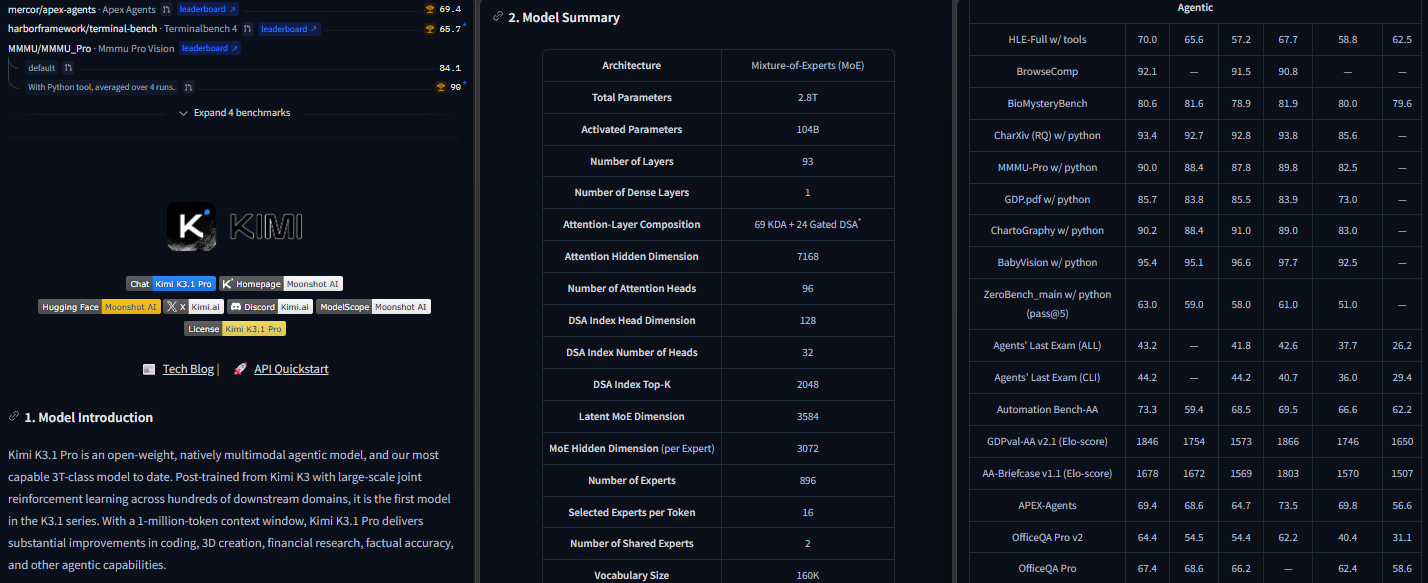
Moonshot AI published the weights of Kimi K3.1 Pro (about 2.8T parameters, ~104B active, 1M context) in early November 2026. We read the config: 69 Kimi Delta Attention layers with a fixed-size state, 24 latent-attention layers with a new top-2,048 sparse indexer. We compute the cache (about 17.8 GB per 1M-token sequence in FP8), explain the cyber-data removal and its measured effect, and read the licence.
Fact sheet
- Model
- Kimi K3.1 Pro
- Vendor
- Moonshot AI
- Parameters
- ~2.8T total MoE (2,780,110,363,392 per Hugging Face), ~104B active per token
- Context
- 1M tokens (max_position_embeddings 1,048,576)
- Released
- 2026-11
- Licence
- Open weights · restricted licence Kimi K3.1 Pro License (modified MIT, MaaS revenue + attribution terms)
| Benchmark | Result | Provenance & comparison | Source |
|---|---|---|---|
| Terminal-Bench 4.0Claude-Code harness, max reasoning effort, temperature 1.0, top-p 0.95 | 65.7 % | Self-reported | source ↗ |
| BrowseComptemperature 1.0, top-p 1.0 | 92.1 % | Self-reported | source ↗ |
| HLE-Full (with tools)max reasoning effort | 70.0 % | Self-reported | source ↗ |
| GPQA-Diamondmax reasoning effort | 94.2 % | Self-reported | source ↗ |
| xdev-bench-hard (internal exploit benchmark)pass@3; 90.5% for a checkpoint without cyber-data removal, 33.3% for Kimi K3 | 81.0 % | Self-reported | source ↗ |
Self-reported numbers come from the vendor itself, often with its own prompts and settings. Treat them as claims until independent or reproduced results exist.
In short
Moonshot AI made the weights of Kimi K3.1 Pro public on Hugging Face in the first days of November 2026 (the repository was created on 2 November; vLLM published day-0 support on 4 November). The model has about 2.8 trillion parameters in total, about 104B active per token, a 1M-token context, and text plus image input. It is a further post-trained Kimi K3 with one architecture change: the 24 full-attention layers now use a sparse-attention indexer (DSA) on top of latent attention (MLA). Moonshot also says it removed cyber-attack data from training for the open release and published how much that lowered its own exploit benchmark. The licence is a modified MIT licence with a revenue condition for Model-as-a-Service providers and an attribution rule for very large products.
How it works
Mixture of experts. Each of the 93 layers (the first one is dense) has 896 routed experts and 2 shared experts. A router sends every token to 16 routed experts. Compute per token is close to that of a ~100B dense model; memory for the weights is that of a 2.8T model. The weights are stored in MXFP4 (4-bit, group size 32, from quantization-aware training), so the checkpoint is roughly 1.5 TB (our estimate: 2.78T parameters × about 4.25 bits including scales).
Two kinds of attention layers. The config lists two layer types:
- 69 Kimi Delta Attention (KDA) layers. These are linear-attention layers. Instead of a cache that grows with every token, each layer keeps a fixed memory matrix per head and updates it with the delta rule: for a new key, it reads what the memory currently returns, and writes only the difference to the new value. A learned gate lets the memory forget. According to Moonshot's Kimi Linear paper, KDA extends Gated DeltaNet with a finer-grained (per-channel) gate.
- 24 full-attention layers (every 4th layer, plus the last one). They use multi-head latent attention: per token, one compressed vector of 512 numbers plus a 64-number rotary key part is cached. New in K3.1 Pro: each of these layers also has an indexer with 32 small heads of 128 dimensions. The indexer scores all earlier tokens and keeps the top 2,048; exact attention then runs only over those tokens.
Analogy: the KDA layers are a notebook of fixed size that is rewritten while reading; the full-attention layers are an archive that keeps everything, and the indexer is the catalogue that picks which 2,048 pages to open.
Under the hood
Architecture numbers from config.json (text_config, linear_attn_config, dsa_config): num_hidden_layers 93, hidden_size 7168, 96 attention heads, kv_lora_rank 512, qk_rope_head_dim 64, max_position_embeddings 1,048,576; KDA with 96 heads of dimension 128 and a short convolution of kernel size 4; DSA with index_topk 2048, index_num_heads 32, index_head_dim 128, index_rope_dim 0 (no positional encoding in the indexer); MoE with 896 experts, 16 per token, expert width 3072, latent MoE dimension 3584; num_nextn_predict_layers 0 (no built-in multi-token prediction head). Vision encoder: MoonViT-V2 (27 layers, about 401M parameters per the model card).
Memory per sequence (our calculation from the config).
| Part | Size | Grows with context? |
|---|---|---|
| MLA latent, 24 layers × (512 + 64) | 13,824 numbers per token | yes |
| DSA indexer keys, 24 layers × 128 | 3,072 numbers per token | yes |
| KDA state, 69 layers × 96 heads × 128 × 128 | 108.5M numbers | no |
With an FP8 latent and FP8 indexer keys (132 bytes per key including the scale, as in vLLM's post) this is 16,992 bytes per token, which matches the figure vLLM reports. At 1,048,576 tokens that is about 17.8 GB per sequence, plus about 0.22 GB (BF16) or 0.43 GB (FP32) of KDA state that does not grow. If all 93 layers were MLA, the latent cache alone would be 3.9 times larger. The indexer adds about 23% to the cache of K3 (13,824 → 16,992 bytes per token), but at long context it lets each sparse layer read about 23% of the bytes that dense MLA reads (vLLM's figure).
Serving. vLLM's day-0 post shows tensor parallelism over 8 GPUs (GB300 or MI355X), a decode-context-parallel mode that shards the cache by token (about 21.8M cached tokens on 8× GB300 with FP8, versus about 3.04M with plain TP8), and a DSpark speculative-decoding draft model. These are vLLM's own measurements.
Removing cyber data. Moonshot writes that cyber-related data was present in its mid-training corpus and its RL environments, and that it removed both for the open-weight model while keeping general coding tasks. On its internal exploit benchmark xdev-bench-hard (pass@3), a checkpoint without this removal solved 90.5% of tasks, the released model 81.0%, and Kimi K3 33.3%. So the filter lowered the score by about 10 points, but the released model is still far above K3. The model card also lists ExploitBench 74.7 and ExploitGym 20.7 (self-reported, with the harness budgets on the card). Moonshot says the model stays behind proprietary models that have been public for at least three months; we could not check this. Tencent's Hy4, released the same week, is also described as trained without offensive hacking material; we have not read its report yet.
Benchmarks. All numbers in the fact sheet are Moonshot's own (max reasoning effort, temperature 1.0, top-p 0.95, vendor harnesses; Terminal-Bench 4.0 with a Claude-Code harness). Several benchmarks on the card are internal. Moonshot's comparison numbers for other vendors come from the same table and are not independent; a Business Insider report on Artificial Analysis's private test set (November 2026) says open-weight models score further behind the leaders there than on public benchmarks.
Licence ("Kimi K3.1 Pro License"). MIT-style grant (use, modify, distribute, sell, fine-tune) with two conditions: (1) a company that runs a Model-as-a-Service business with more than $20M revenue in any 12 months needs a separate agreement before commercial use; (2) products with more than 100M monthly active users or more than $20M monthly revenue must show "Kimi K3.1-Pro" in the user interface. Internal use that does not expose the model to third parties is exempt. The licence does not mention training other models on outputs. We classify it as open-restricted. This is our reading, not legal advice.
Unknowns. Training data and compute are not published. The KDA state precision used by inference engines is not documented in the config, so our state size is a range. Running the full model needs a multi-GPU server; we did not run it.
Try it yourself
- Compute the cache. The first Python snippet below recomputes the table from the config values. Expected output includes
FP8 latent + FP8 index (132 B incl. scale): 16,992 bytes/tokenand1,048,576 tokens -> 17.82 GB per sequence. The site's KV-cache calculator has a draft preset "Kimi K3.1 Pro" with the same values (indexer keys are not part of the calculator). - See why a delta-rule memory forgets. The second snippet stores 40 key–value pairs in a 64×64 state and reads them back. Expected (seed 0): mean recall cosine 0.80 without forgetting and 0.45 with a decay of 0.9; the newest pair is always recalled exactly. This is the trade-off the KDA gate learns per channel: forgetting frees room for new tokens but loses old ones, which is one reason the model keeps 24 full-attention layers.
- Serve it (needs 8 large GPUs; we did not run this): follow the vLLM post and the model card. The core flags shown there are
--tensor-parallel-size 8 --trust-remote-code --tool-call-parser kimi_k3 --reasoning-parser kimi_k3. The post does not name a minimum vLLM version, so record the version you install.
Python in your browser
Play with it
Sources
- Hugging Face: moonshotai/Kimi-K3.1-Pro (model card)
- Kimi-K3.1-Pro config.json
- Kimi K3.1 Pro License (LICENSE file)
- Moonshot AI: Kimi K3.1 Pro announcement
- vLLM blog: Day-0 support for Kimi K3.1 Pro (4 Nov 2026)
- Kimi Linear: An Expressive, Efficient Attention Architecture (arXiv:2510.26692)
- TechNode: Moonshot AI releases Kimi K3.1 Pro model weights (5 Nov 2026)
- The Next Web: Moonshot releases Kimi K3.1 Pro and says it cut its hacking skills
- Tencent: Tencent launches Hy4 open-source model
- Business Insider: Artificial Analysis private tests and open-weight models (Nov 2026)
What should happen next with this?
One click per article, no account needed. “Go deeper” feeds the research queue.