Mistral Large 4 weights are out: a 1T mixture-of-experts model with latent attention, a sparse indexer and cross-layer KV reuse
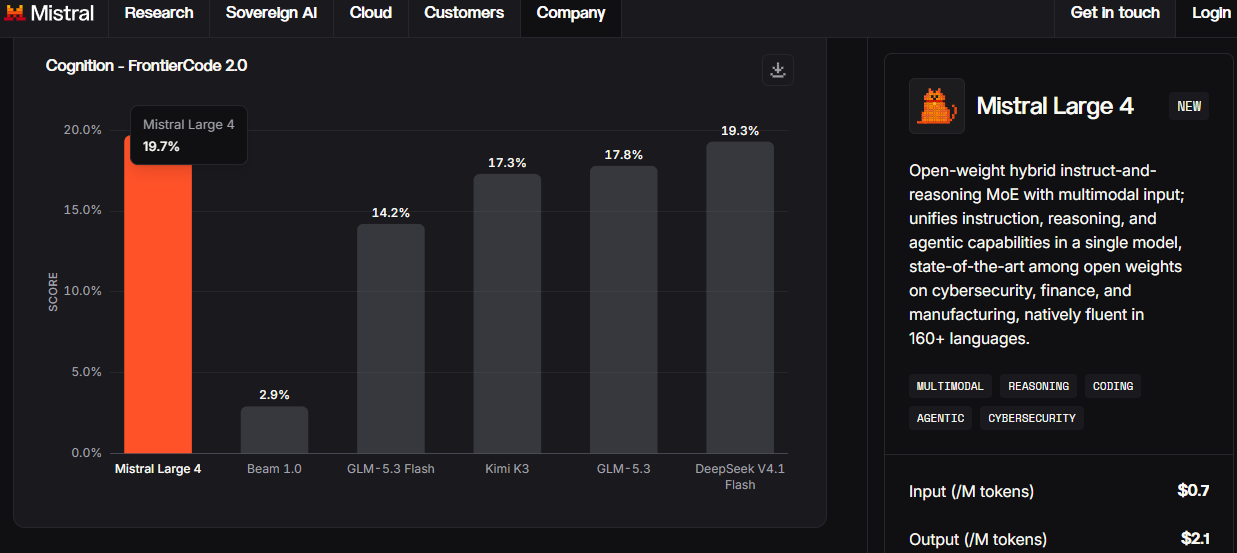
Mistral published the weights of Large 4 (about 1T parameters, ~49B active, 1M context) on 29 October 2026 under a modified MIT licence with a Model-as-a-Service clause. We read the config: DeepSeek-style latent attention, a top-2,048 sparse indexer, and nine layers that reuse layer 35's KV cache. We compute the cache size and explain why the 41% Terminal-Bench score depends on Mistral's own harness.
Fact sheet
- Model
- Mistral Large 4 (Mistral-Large-4-1T-A52B)
- Vendor
- Mistral AI
- Parameters
- ~1T total MoE, ~49B active per token (52B incl. embeddings and output layer)
- Context
- 1M tokens (max_position_embeddings 1,048,576)
- Released
- 2026-10
- Licence
- Open weights · restricted licence Mistral Ecosystem Open-Weight License (modified MIT)
| Benchmark | Result | Provenance & comparison | Source |
|---|---|---|---|
| Terminal-Bench 4.0Mistral's own Vibe agent harness, high reasoning effort | 41 % | Self-reported | source ↗ |
| Terminal-Bench 4.0Artificial Analysis, generic mini-swe-agent harness, as reported by AI Realist | 24.7 % | Independent | source ↗ |
| BrowseCompsetting not stated | 84.5 % | Self-reported | source ↗ |
Self-reported numbers come from the vendor itself, often with its own prompts and settings. Treat them as claims until independent or reproduced results exist.
In short
Mistral AI published the weights of Mistral Large 4 on Hugging Face on 29 October 2026, three weeks after the public preview of 6 October. It is a mixture-of-experts model with about 1 trillion parameters, of which about 49B are active per token (52B including embeddings and output layer), with a 1M-token context and text plus image input. The licence is a modified MIT licence that is permissive for most uses but requires a separate commercial contract for "Model-as-a-Service" businesses. The config.json shows a design close to DeepSeek's: latent attention (MLA), a sparse-attention indexer, and one detail we have not seen in DeepSeek configs: nine layers reuse the KV cache of layer 35. Mistral's headline coding score depends strongly on Mistral's own agent harness.
How it works
Mixture of experts. Each of the 72 layers (the first one is dense) has 128 routed experts and 1 shared expert; a router sends each token to 4 routed experts. So most of the 1T parameters sit idle for any single token, and compute per token is close to that of a ~50B dense model, while memory for the weights is that of a 1T model.
Three ways to keep long context affordable, all visible in text_config:
- Latent attention (MLA). Instead of storing keys and values for 64 heads, each layer stores one compressed vector of 512 numbers (
kv_lora_rank) plus a 64-number rotary key part (qk_rope_head_dim) per token. Keys and values are re-expanded from this latent when needed. - Indexed (sparse) attention. All 72 entries of
layer_typesare"indexed_attention". A small indexer (32 heads of size 128,index_n_heads,index_head_dim) scores all previous tokens, and full attention only runs over the best 2,048 (index_topk). The config also has anindexer_typeslist with"full"and"shared"entries; the model card does not explain it, so we do not guess what "shared" means. - Cross-layer KV reuse. The
kv_source_layerslist maps each layer to the layer whose cache it reads. For layers 39, 43, 47, …, 71 (every fourth layer from 39 on, nine layers in total) the entry is 35, not the layer's own index. Those nine layers do not store their own cache. A newsletter analysis of the config (AI Realist, 1 November) reads it the same way. The model card does not mention it.
Analogy for the indexer: a librarian first scans the catalogue cards of every book (cheap), then reads only the 2,048 most promising books in full (expensive).
Licence. The Mistral Ecosystem Open-Weight License allows use, modification, redistribution, fine-tuning and sale, with attribution. Section 2 requires a separate commercial licence if you run the model "as a Service": giving third parties API-like access in which they control inputs, parameters or training data. Internal use and end-user products that embed the model only inside specific features are exempt. There are no user or revenue caps. Because of the service clause we classify it as open-restricted, not open-source. This is our reading, not legal advice.
Under the hood
Numbers from the config (mistralai/Mistral-Large-4-1T-A52B, text_config):
| Field | Value |
|---|---|
| hidden_size / layers | 6,144 / 72 (first layer dense: first_k_dense_replace = 1) |
| attention heads | 64, query-key head dim 128 (64 no-RoPE + 64 RoPE), value head dim 128 |
| MLA latent / RoPE key | 512 / 64 |
| experts | 128 routed, 4 per token, 1 shared; expert width 6,144 |
| indexer | 32 heads × 128, top-k = 2,048 |
| context | max_position_embeddings 1,048,576 (YaRN, factor 2,048 over 512) |
| vocabulary | 204,800 |
| weights | FP8 block-quantised (128×128 blocks) in the main repo; separate NVFP4 repo for Blackwell GPUs |
KV-cache size. Per token, the cache holds (512 + 64) numbers for each of the 63 layers that keep their own cache: 36,288 numbers, or 70.9 KiB in BF16. A full 1M-token sequence then needs about 76 GB in BF16 or 38 GB in FP8, plus the indexer's own keys, whose storage format is not documented. Without the cross-layer reuse, the cache would be 14% larger (72 instead of 63 layers). The preset "Mistral Large 4" in the KV-cache calculator uses these numbers (draft, awaiting review).
What the sparse indexer buys. Attention cost per new token falls from "all previous tokens" to 2,048 tokens plus the cheap indexer pass. At 1M context that is about 0.2% of the tokens for the expensive part. The price is a selection error: a relevant token that the indexer ranks low is invisible to the attention heads.
Speculative decoding. The checkpoint includes a draft head that Mistral calls DSpark: 3 dense MLA layers in BF16 that propose blocks of 3 tokens. Mistral reports up to 1.9× throughput; outputs are unchanged because the main model verifies every token. We have not measured this.
Benchmarks: the harness matters. Mistral reports 41% on Terminal-Bench 4.0, up from 28% for the preview. That run used Mistral Vibe, Mistral's own coding agent, at high reasoning effort. According to an analysis by AI Realist (1 November 2026), Artificial Analysis measured about 25% with the generic mini-swe-agent harness, and Vals AI measured 26.3% ± 5.1 with a generic harness, about the same as the preview (27.8%). So the gain is real inside Mistral's harness, but it does not show up in a generic one. Possible causes are RL training on Vibe-like tasks, harness settings, or both; the public data cannot separate them. Other self-reported numbers: BrowseComp 84.5%, Artificial Analysis Coding Agent Index 48%. Do not compare these with other vendors' self-reported numbers without checking the harness.
Hardware. The model card's examples use 8 GPUs with tensor parallelism. The Next Web reports that a quantised version runs on four B200 or B300 GPUs. The FP8 weights alone need roughly 1 TB, so this is a data-centre model. Training used 3,800 Grace Blackwell GPUs, according to the model card.
Unknowns. Mistral has not published a technical report. The meaning of indexer_types, the indexer cache format, and the training data are not documented.
Try it yourself
You cannot run a 1T model in a browser, but you can check the two cache-saving ideas.
- Cache size from the config. The first snippet computes the KV-cache size from the published config values, with and without the nine reused layers. Expected output: 63 layers with their own cache, 70.9 KiB per token in BF16, 76.1 GB for 1,048,576 tokens.
- Top-k attention on toy data. The second snippet builds 16,384 random keys, hides 64 relevant ones, uses a random 32-dimensional projection as a stand-in indexer, and compares top-k attention with full attention. With k = 2,048 (12.5% of the tokens here) it keeps about 98% of the attention mass and finds 97% of the relevant tokens. A random projection is a much weaker indexer than a trained one, so read this as a lower bound on quality at a given k.
- Serving (data-centre GPUs only). The model card gives
vllm/vllm-openai:mistral-large-4with--tensor-parallel-size 8 --tool-call-parser mistral --reasoning-parser mistral --enable-auto-tool-choice, and--speculative-config '{"method": "dspark", "num_speculative_tokens": 3}'for the draft head. We could not test this. Recommended sampling: temperature 1.0, top_p 0.95.
Python in your browser
Play with it
Sources
- Mistral AI: Mistral Large 4 (Le Chonk) is now open weight
- Hugging Face: mistralai/Mistral-Large-4-1T-A52B (model card)
- Mistral-Large-4-1T-A52B config.json
- Mistral Ecosystem Open-Weight License (LICENSE file)
- Mistral AI: Introducing Mistral Large 4 (preview, October 2026)
- AI Realist: Mistral Large 4 weights – the score comes with the harness (1 Nov 2026)
- The Next Web: Mistral releases open weights for its 1T-parameter Large 4 model (29 Oct 2026)
What should happen next with this?
One click per article, no account needed. “Go deeper” feeds the research queue.