Balestriero and LeCun prove a version of the Platonic Representation Hypothesis for JEPAs, and call next-token prediction an inefficient route
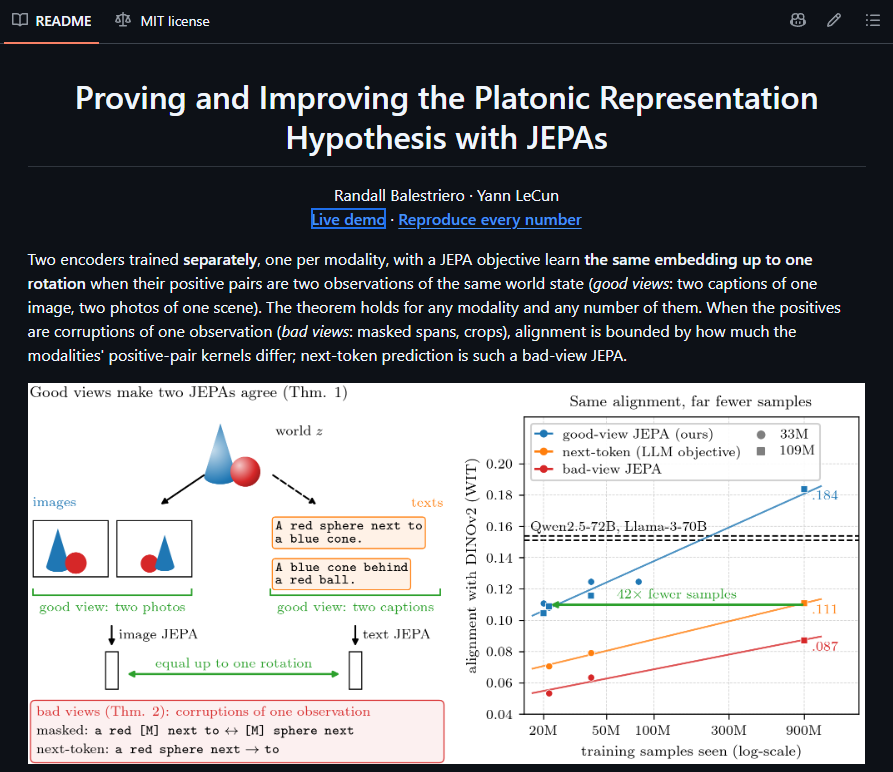
A 29 October preprint proves that JEPAs trained separately on different modalities with 'good views' learn the same representation up to a rotation, and argues that next-token prediction uses 'bad views'. A 109M text JEPA aligned with image encoders better than language models up to 72B and needed 42x fewer samples. We explain good and bad views and recover the rotation in a numpy toy.
In short
The Platonic Representation Hypothesis (Huh et al., 2024) observed that vision models and language models, trained separately, become more similar in how they arrange concepts as they grow. A preprint by Randall Balestriero and Yann LeCun (arXiv:2610.39302, 29 October 2026) gives a proof for one family of models: joint-embedding predictive architectures (JEPAs) trained separately on different modalities learn the same representation up to a rotation, if their training pairs are "good views" (two observations of the same scene). The paper argues that next-token prediction uses "bad views", which explains why language models align with vision only slowly, through scale. In experiments, a 109M-parameter text JEPA aligned with image encoders better than all tested language models up to 72B parameters, and reached a given alignment with 42 times fewer samples than next-token training on the same corpus. The results are not peer-reviewed.
How it works
JEPA in one sentence. Show the model two views of the same thing, and train it so that their embeddings match, while a regulariser stops all embeddings from collapsing to the same point. There is no reconstruction of pixels or tokens.
Good and bad views.
- Good views are two independent observations of one world state: two captions of the same image, or two camera angles of one scene. What they share is the scene; their nuisances (wording, lighting) are independent.
- Bad views are two pieces of one observation: two crops of one photo, or a text prefix and its continuation. They share the scene and nuisance (the same author's style, the same camera noise), so the model can spend embedding dimensions on that nuisance.
The claim. If two modalities are trained separately with good views of the same underlying world, each JEPA learns the world's structure and nothing else, so the two embedding spaces differ only by a rotation. One rotation, fitted on a few paired examples, then maps one space onto the other.
Analogy: two people describe the same city, one from photos and one from guidebooks. If both describe only the city, their maps differ only in which way is "up". If one of them also maps the photographer's habits, the maps no longer fit together by a simple turn.
Under the hood
Theorem and assumptions. Theorem 1 holds in an idealised setting: a finite world, each modality renders world states without losing information (injectively), training reaches the population optimum, and the optimum is unique up to rotation. Uniqueness is shown for whitened squared-distance JEPAs under a spectral gap; for LeJEPA's SIGReg regulariser it is assumed. The result covers spectral contrastive learning, whitened MSE, VICReg and Barlow Twins (in a whitened limit), and SIGReg. It covers identity predictors only, not the action-conditioned predictors used in world models.
Next-token prediction as a bad-view JEPA. The softmax loss can be split into a prediction term (inner product with the target token's vector) and an anti-collapse term (the log-partition). Its positive pairs are a prefix and its continuation in one document, so it is a bad-view JEPA. The authors call this reading heuristic, because next-token models are identified only up to an invertible linear map, not a rotation.
Experiments (all from the paper; metrics: mutual 10-nearest-neighbour overlap, chance 0.01; and retrieval after one fitted orthogonal map):
| Result | Number |
|---|---|
| Data range of the validation | 145k captions up to the texts of 940M web images |
| Samples to reach the alignment of next-token training with 900M samples | 21.6M with good views (42× fewer) |
| 109M text JEPA (BERT-B, 116B text tokens, alt-text plus two LLaVA recaptions per image as views) on the WIT-1024 alignment benchmark | 0.184, above Qwen2.5 (0.5B–72B), Llama-3 8B and 70B, Mistral-7B, and CLIP's text encoder (0.124) |
| Captioner: one linear map with orthonormal rows, fitted on 30k Flickr pairs, from frozen DINOv2/v3 embeddings to a text-only fine-tuned language model | CIDEr 0.838 on COCO (consensus of 32 samples) |
| Pair-free matching on ImageNet-100 (Schnaus et al. benchmark) | 64% top-5, versus at most 56% for language models up to 8B |
The paper also fits a scaling law of alignment in the fraction of good views and the number of samples, and reports that it predicts 85 unseen runs about as well as re-running with another seed.
Limits. The theory assumes ideal conditions. Image JEPAs trained on crops are themselves bad-view models; good image views need several observations of one scene (for example video frames), and the paper's video JEPA, trained on 7k MSR-VTT clips, is much weaker than DINOv2. Embeddings of different sizes are aligned with a linear map that the theory does not cover. Some results use a single seed. Alignment with an image encoder is not the same as being a better language model: the paper does not claim the 109M JEPA can generate text like a 72B model.
Why it matters. If the result generalises, multimodal models do not need huge paired datasets: train each modality separately with good views, then fit a rotation on a small paired set. It also suggests that how training pairs are chosen can matter more than model size for cross-modal alignment.
Try it yourself
Linear toy (the snippet below). A hidden 16-dimensional "scene" is seen through two random linear mixings ("image" and "text"). Each encoder is trained alone, on its own modality, by whitening, which is the linear version of the JEPA anti-collapse constraint. Then one orthogonal matrix is fitted on paired examples (orthogonal Procrustes: the SVD of Hᵢᵀ Hₜ). Expected output with seed 0: with good views (all 16 factors shared) the mean cosine on 1,000 held-out pairs is 0.98 and retrieval top-1 is 100%. When the text side sees only 12 or 8 of the 16 factors and replaces the rest with its own nuisance (bad views), top-1 drops to 59% and 14%. With good views, 20 paired examples already give 100%. This toy only shows the geometry; whitening recovers the scene up to rotation here because everything is linear, which is exactly the part the theorem has to prove for real networks.
The real code. The authors link galilai-group/prh-proof on GitHub and a demo Space galilai-group/prh_demo on Hugging Face. We have not run them.
Python in your browser
Sources
What should happen next with this?
One click per article, no account needed. “Go deeper” feeds the research queue.