AIRoA-0: a two-arm robot model trained only on 16,151 hours of handheld human demonstrations, with open weights
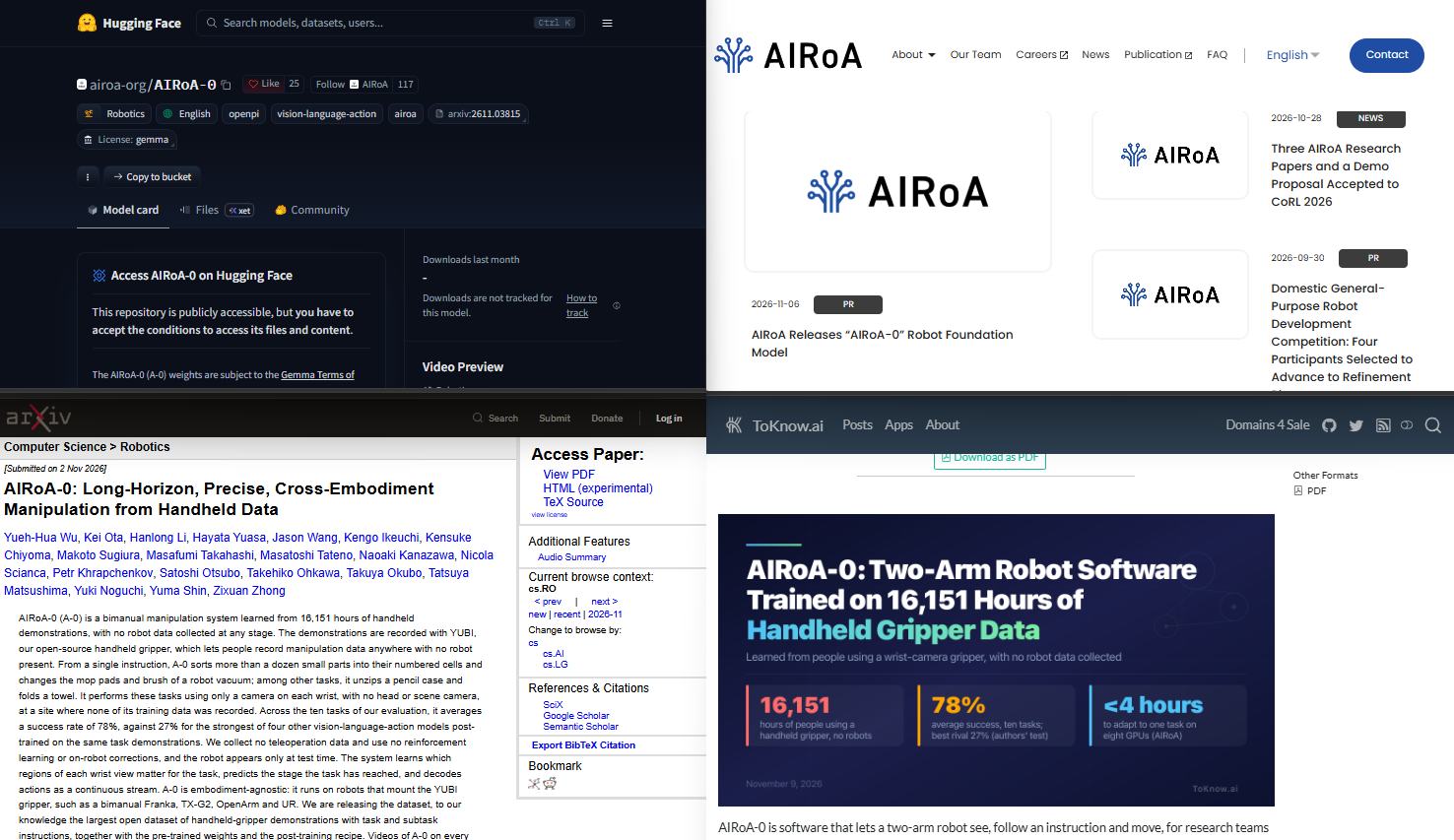
Japan's AI Robot Association released A-0, a 3.36B vision-language-action model built on π0.5 and trained without any robot data. We explain the handheld YUBI data, the robot-independent action format, the visual budget gate, stage head, motion memory and two-pass streaming decoder, the reported 78% on ten tasks (baselines 14–27%), what is not shown, and the Gemma-based licence.
Fact sheet
- Model
- AIRoA-0 (A-0)
- Vendor
- AI Robot Association (AIRoA), Japan
- Parameters
- 3.36B (π0.5 base: SigLIP + Gemma 2B + 300M action expert)
- Released
- 2026-11
- Licence
- Open weights · restricted licence Gemma Terms of Use (weights, gated); code Apache-2.0
| Benchmark | Result | Provenance & comparison | Source |
|---|---|---|---|
| Ten bimanual tasks, unseen site (Franka)15 trials per task, partial credit; best baseline 27 (π0.5, trained by the A-0 authors) | 78 % | Self-reported | source ↗ |
| Inference latency per queryone H200 GPU, about two action-expert passes | 60 ms | Self-reported | source ↗ |
Self-reported numbers come from the vendor itself, often with its own prompts and settings. Treat them as claims until independent or reproduced results exist.
In short
The Japanese AI Robot Association (AIRoA) released AIRoA-0 (A-0) on 6 November 2026: a vision-language-action model for two-armed manipulation that was trained on 16,151 hours of demonstrations recorded by people with a handheld gripper, and on no robot data at all. On ten tasks at a site that is not in the training data, the authors report 78% average success, against 27% for the best of four other models trained on the same task data. Weights (3.36B parameters, gated, under Google's Gemma terms) and Apache-2.0 training code are public. The result matters because handheld data is much cheaper to collect than teleoperation of real robots.
How it works
Data without robots. A person holds a gripper called YUBI in each hand. Closing the hand closes the jaws. Each gripper has a wrist camera and is tracked in six degrees of freedom. The recording contains what a robot with the same gripper would see and do: two wrist images, two gripper paths and two gripper openings.
Actions without a robot body. The model does not output joint angles. It outputs where each gripper should move next, relative to where it is now. Each robot's own controller turns these gripper poses into arm motion. The same weights therefore run on a Franka pair, a UR pair, the OpenArm and the TX-G2 humanoid, as long as the YUBI gripper is mounted.
A base model plus four additions. A-0 starts from the π0.5 weights of Physical Intelligence and adds: a gate that learns which image regions matter, a prediction of the current task stage, a short memory of recent motion, and a faster way to generate actions.
Analogy: a craftsperson's glove that records the hand; any arm that can wear the same glove can replay the skill.
Under the hood
Base. π0.5: SigLIP So400m/14 image encoder, Gemma 2B vision-language backbone, and a 300M-parameter action expert trained with flow matching. The Hugging Face card gives 3.36B parameters in total. Inputs are two 224×224 wrist images, the instruction and the robot state.
Action representation. For a gripper pose T (a 4×4 transform) at time i, the k-th action is a_k = T_i⁻¹ · T_(i+k): the future pose expressed in the current gripper frame. Per arm this is 3 numbers for translation and 6 for rotation, plus one gripper command, so 20 numbers for two arms. The state is the pose of one gripper in the frame of the other plus both openings (11 numbers). No base frame, joint or world coordinate appears, which is what makes the data robot-independent. Actions are produced at 20 Hz. The paper gives the chunk length once as 32 and once as 20 actions; we could not resolve this.
Visual budget gate. Each image token p gets a keep probability m_p = σ(h(z_p, q, z_p⊙q)/τ), where q summarises the prompt. Token features are multiplied by γ + (1−γ)·m_p. A loss (mean(m_p) − ρ)² fixes only the average share of tokens that stay on (ρ = 0.9 in post-training, τ = 0.805, γ annealed from 0.1 to 0.02). Which tokens stay on is learned from the action loss alone; nobody labels image regions. The gate is also added as a bias log(e^(−κ) + (1−e^(−κ))·m_p) with κ = 4 to the attention from actions to image tokens.
Stage head. A head on the backbone predicts which stage of the task has been reached (labels come from subtask annotations). The predicted stage is given to the action expert as text. At run time the stage probabilities are smoothed with an exponential moving average, so one bad frame does not make the robot jump back.
Proprioceptive memory. The last 10 robot states with their elapsed times are compressed by four learned queries into 4 tokens. During training the history is sampled at 5–15 Hz and dropped 25% of the time, so the model does not depend on it.
Streaming decoding. Standard flow matching denoises each action chunk in about ten passes of the action expert. A-0 keeps two chunks in a buffer at noise levels 0.1 and 1 and moves them down one level at a time, so a query needs about two passes. Reported latency is about 60 ms per query on one H200 GPU. The decoder adds no parameters; it needs training with matching noise levels.
Training.
| Pre-training | Post-training (per task) | |
|---|---|---|
| Data | 16,151 h, 10.65M subtask segments, 1.74B time steps at 30 Hz, more than 100 tasks | 3.3 to 25.8 h |
| Steps / batch | 300,000 / 2,048 | 20,000 / 64 |
| Compute | not reported | under 4 h on one node with eight H200 GPUs |
| Loss | — | L_act + 0.1·L_budget + 0.1·L_stage + 0.01·L_subtask |
Post-training uses AdamW with learning rate 5×10⁻⁶ and deploys an EMA of the weights (decay 0.99).
Results (self-reported). Ten tasks on a Franka pair at an unseen site, 15 trials per task, partial credit counted.
| Task | Task data (h) | A-0 | π0.5 | XR-1 | GR00T N1.7 | MolmoAct2 |
|---|---|---|---|---|---|---|
| Colour sorting | 4.1 | 97 | 45 | 39 | 20 | 19 |
| Fuel bracket | 6.3 | 93 | 34 | 33 | 47 | 11 |
| Orange pyramid | 3.4 | 90 | 2 | 52 | 13 | 28 |
| Letter blocks | 3.4 | 84 | 13 | 0 | 24 | 0 |
| Parts kitting | 4.0 | 83 | 30 | 13 | 7 | 12 |
| Cup pyramid | 17.9 | 80 | 71 | 11 | 23 | 36 |
| Towel folding | 3.3 | 73 | 22 | 21 | 0 | 8 |
| Robot vacuum parts | 5.3 | 73 | 1 | 14 | 1 | 3 |
| Pencil case | 8.8 | 73 | 36 | 31 | 15 | 23 |
| Earbuds | 25.8 | 30 | 13 | 18 | 10 | 3 |
| Average | 78 | 27 | 23 | 16 | 14 |
The baselines were trained by the A-0 authors, not by their own authors; each baseline got a search over action horizon, frequency and training length, and its best result is shown.
Scaling. Post-training loss follows L = 0.063 · D^(−0.035) in the pre-training hours D (R² = 0.98 between about 1,000 and 16,000 hours): each doubling of data lowers the loss by about 2.4%. This is a statement about loss, not about success rate.
What is missing.
- No ablation shows how much the gate, the stage head, the memory or the streaming decoder each contribute to success.
- 15 trials per task give wide intervals: 73% from 15 trials is compatible with roughly 48% to 89%.
- Results on the other three robots are videos without success rates.
- The earbuds task stays at 30% even with the most task data, without a failure analysis.
- The model needs the YUBI gripper on the robot and sees only wrist cameras.
- The 16,151-hour dataset is announced but not released; timing and scope are open.
Licence. The weights are gated on Hugging Face under the Gemma Terms of Use with Google's prohibited-use policy, because the backbone is Gemma; derivatives must carry these terms. The AIRoA-0 code and the π0.5/openpi parts are Apache-2.0. This is "open weights with use restrictions", not open source.
Try it yourself
Three Python live snippets cover the ideas that carry over to other projects.
- Anchored relative poses. Builds a gripper path, expresses it as a_k = T_i⁻¹ · T_(i+k), then views the same motion from a different base frame. Expected:
max difference after changing the base frame: 4.3e-16, while the absolute poses differ by up to 2.00. This is the whole reason the data transfers between bodies. - Budget gate. 256 image tokens, 20 of them relevant. With budget 0.9 almost everything stays on; with budget 0.1 the relevant tokens keep 0.82 and the others 0.04. Expected first line:
budget 0.9: mean keep 0.90, relevant tokens 1.00, other tokens 0.89, smallest scale 0.380, loss 1.2e-32(the last digits of the loss can differ by platform). - Scaling law and noise levels. Expected:
gain per doubling of data: 2.4%, and for the two buffer slotsnoise between 0.00 and 0.10andnoise between 0.10 and 1.00.
To use the real model you need a Linux machine with an NVIDIA GPU (CUDA 12), Python 3.11, and a Hugging Face account that has accepted the conditions. The model card gives these commands; we did not run them:
hf download airoa-org/AIRoA-0 --include "pretrained/*" --local-dir AIRoA-0   # about 12 GB
cd AIRoA-0/pretrained && sha256sum -c SHA256SUMS
Fine-tuning uses the repository airoa-org/AIRoA-0 (./run.sh inspect, ./run.sh norm, ./run.sh train) with data in LeRobot v3.0 format; the default setup is 8 GPUs. The card warns that plain openpi cannot load the visual gate, the stage head or the memory: use the AIRoA-0 code.
Python in your browser
Sources
What should happen next with this?
One click per article, no account needed. “Go deeper” feeds the research queue.