HALO: Apple trains a Unitree G1 humanoid on 296 hours of fully synthetic vision-language-motion data and reaches 91% in unseen real rooms
Apple's HALO (arXiv:2611.06908) generates whole-body motion with a diffusion model, places it in 1,000 procedural rooms, renders the robot's camera view, and trains a three-layer controller: VLM orchestrator, flow-matching motion generator, depth-based RL tracker. Six skills reach 91% in 360 real trials without teleoperation data; chained tasks drop to 50-100%. We explain the pipeline, the ablations and the statistics.
In short
Apple researchers posted HALO ("Humanoid Autonomy, Learned in simulation, running Onboard", arXiv:2611.06908, 4 November 2026). A stock Unitree G1 humanoid learns six whole-body skills (go to a named object, sit on a chair, step through a half-open door, crouch under a table, crawl under a low table, push a box) only from synthetic data: about 296 hours of vision–language–motion examples generated in 1,000 procedurally built rooms, with no teleoperation data. In six real, unmapped environments it succeeded in 91% of 360 single-skill trials. The point of the paper is the scaling argument: teleoperation costs at least one human hour per hour of data, while this pipeline scales with GPUs. The code is published; trained weights and the dataset are not.
How it works
HALO splits control into three layers that run at different speeds:
- Orchestrator (every ~2 s). An off-the-shelf vision-language model (default Qwen3.6-35B-A3B, 4-bit) breaks a request such as "go sit on the chair by the window" into subtasks and decides when to move on or retry.
- Motion generator (~3 Hz). It sees one camera image plus the current subtask text and outputs a 5-second whole-body motion plan: 150 frames at 30 Hz, each with 29 joint angles and the pelvis position and orientation.
- Motion tracker (50 Hz). A reinforcement-learning policy follows that plan with real physics. It uses depth images, joint history and the IMU, and outputs joint targets for the robot's PD controllers.
The orchestrator and generator run on a Mac mini (M4 Pro, 64 GB) carried on the robot's back; the tracker runs on the G1's own Jetson Orin NX. A wide-angle camera is added in a custom head mount. The robot is not tethered.
The training data are made like a film production. A text-conditioned motion diffusion model (Kimodo) generates human-like motion segments from prompts, waypoints and keyframes; physical checks reject clips with foot skating, floor penetration or joint-limit violations. Infinigen builds the rooms (living rooms, offices, bedrooms). A placement search puts each motion into a room so the pelvis stays at least 0.35 m from obstacles. Isaac Sim renders what the robot's fisheye camera would see, with random blur, noise, exposure and colour.
Under the hood
Motion generator. A frozen Qwen3.5-2B vision-language model encodes the image (64 image tokens) and the text; its last-layer states are projected to width 512 and condition a diffusion transformer (8 blocks, width 512, 8 heads, 49.3M trainable parameters) trained from scratch with flow matching, sampled with 15 Euler steps. For smooth replanning, the first 15 frames (0.5 s) of each new plan are fixed to the part of the old plan that is already being executed, and only the remaining 135 frames are generated ("real-time chunking", trained with this conditioning). Training: 31.0M samples, 50 epochs, batch 5,120, on 64 B200 GPUs.
Tracker. Input: 30 steps of proprioception history, upcoming plan frames, IMU angular velocity and gravity direction, and a 48×84 depth image (from the stereo IR camera, processed on the Jetson at 30 Hz). Network: 1D CNN for history, 2D CNN for depth, residual MLP. Training in Isaac Lab in three phases: PPO experts per skill family with privileged information (8,192 environments, 50k iterations); multi-teacher DAgger distillation into one student (4,096 environments, 30k iterations); then PPO again with depth rendering in the loop, a shared actor and one critic per skill (16,384 environments on 4 H100s, 50k iterations). Sim-to-real tools: actuator models, action delay, randomised physics and depth noise.
Data. 162,698 episodes, 296.3 hours (about 50,000 Go-To episodes and roughly 19,000–29,000 for each other skill, about 50 hours per skill). 1,178 rooms were generated (1,000 for training, 178 held out); generating them took 26 hours on up to 300 GPUs, and the Sit corpus alone took 48 hours on 250 H100s.
Results (success rate; real: 10 trials per skill in each of 6 environments; simulation: 100 held-out rooms):
| Skill | Simulation | Real |
|---|---|---|
| Go to object | 98% | 92% |
| Sit | 84% | 85% |
| Half-open door | 91% | 93% |
| Crouch under table | 95% | 100% |
| Crawl under table | 84% | 90% |
| Push box | 93% | 88% |
| Mean | 91% | 91% |
Chained tasks (real, 10 trials each, one environment): door then object 100%, crouch then sit 60%, crouch then go to box then push 50%.
Ablations (Sit, simulation): 1 training room 43%, 10 rooms 64%, 100 rooms 81%, 1,000 rooms 84%. Plain regression decoder instead of flow matching 19%. No real-time-chunking conditioning 24% (66% if the chunking is only applied at inference). Tracker without depth 74%.
Limits. Each new skill still needs a human to write prompts and keyframes for the motion generator. There is no touch sensing, and none of the skills involves grasping or hand manipulation. The tracker follows the plan without knowing its purpose. Chained tasks fail more often than single skills, mostly when the next target is out of view; the authors suggest search and turn-in-place behaviours. The paper does not compare against other systems on the same tasks, and real-world trial counts are small (see the second snippet).
Try it yourself
- Why flow matching and not regression. The first snippet models a chair that can be reached left or right of an obstacle. Regression learns the average path, straight into the obstacle; flow matching (exact velocity field, 15 Euler steps as in HALO) samples one of the two valid paths. Expected output (seed 0):
regression output: y = +0.00 -> hits obstacle: yesandflow matching: 51% go left, 49% go right, 0.0% end inside the obstacle. This is the same failure mode behind the 19% of the regression ablation, in one dimension. - How much 10 trials tell you. The second snippet computes 95% Wilson intervals for the real chained-task results and compares them with the product of single-skill rates. Expected: crouch→sit observed 60% with interval [31%, 83%] while the product is 85%; for two of three chains the product lies above the interval.
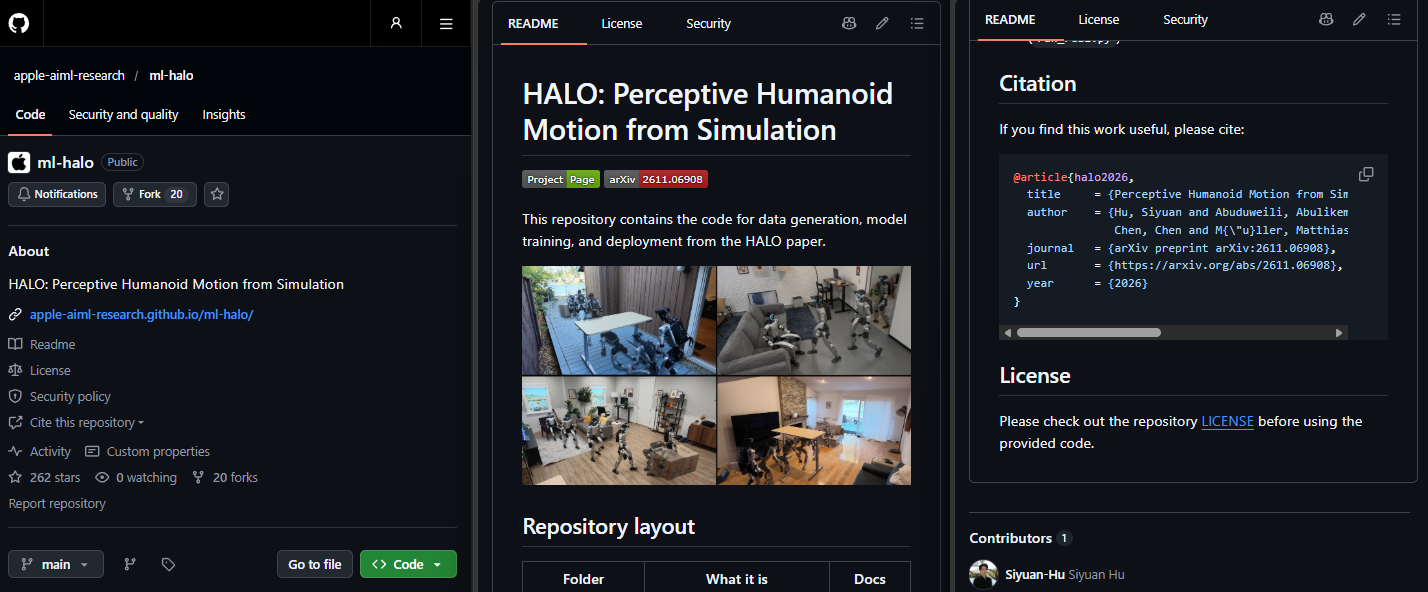
- The real code. The repository apple-aiml-research/ml-halo contains the data-generation pipeline, generator and tracker training, and MuJoCo and G1 deployment code. Reproducing the data needs Isaac Sim and hundreds of GPU-hours; we did not run it. Check the repository for its licence before reuse.
Python in your browser
Sources
What should happen next with this?
One click per article, no account needed. “Go deeper” feeds the research queue.