AutoDNA in Nature: LLM agents that write their own instrument drivers and schedule a shared DNA lab
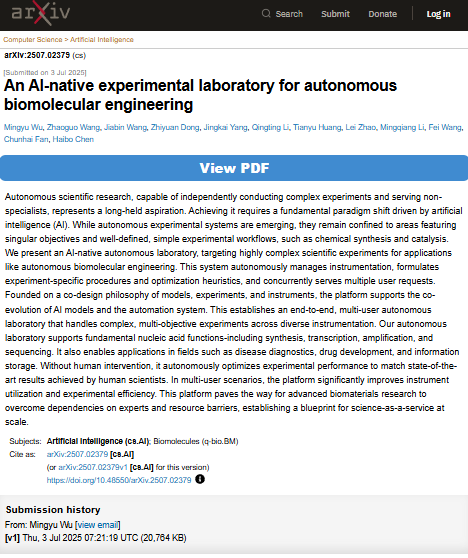
A Shanghai Jiao Tong University team published AutoDNA in Nature on 5 November 2026: planner, literature, reagent, coding and execution agents run nucleic-acid experiments on 20+ instrument types, turn manuals into callable 'atomic services', and share hardware between users. Reported: ~98% stepwise synthesis yield, a full DNA data-storage cycle, ~3x throughput. We explain the architecture, compare preprint and journal numbers, and list what is missing.
In short
On 5 November 2026 Nature published AutoDNA, an "AI-native" laboratory from a team at Shanghai Jiao Tong University (authors include Haibo Chen and Chunhai Fan). LLM agents plan nucleic-acid experiments, write the control code for more than 20 kinds of instruments, run them, check results, and share the hardware between several users. Reported results include enzymatic DNA synthesis with a stepwise yield of about 98%, a complete DNA data-storage cycle (write, store, read, decode) with humans only refilling reagents, and a roughly three-fold throughput gain from scheduling. The interesting part for builders is not one model but the software layer between agents and instruments.
How it works
The system has two halves, each made of specialised agents:
- Chemistry planning. An experiment planner turns a user request into a procedure, a hypothesis proposer suggests changes when results are poor, a literature researcher retrieves methods from papers, and a reagent manager tracks stock and refuses plans that need reagents that are not there.
- Hardware execution. A program developer agent reads instrument manuals and turns each device into atomic services: small Python functions with a plain-language description (for a thermal cycler, for example,
set_tempandstart). It then writes control code from these services. A hardware executor and validator agent runs the code, checks the outcome, and schedules all instruments.
Control code is written as if each protocol had the lab to itself. The scheduler then merges requests from several users: it runs independent steps in parallel, combines similar pipetting steps into one multi-channel motion, and, when an instrument is busy, re-routes a step to a functionally equivalent device (an occupied heater can be replaced by a free thermal cycler set to the same temperature). The Nature version, according to 36Kr's report, adds a digital twin: generated code first runs in simulation, which catches errors such as reading a sample before it has been placed.
Analogy: the agents are a lab team that writes its own device drivers from the manuals, and the scheduler is the lab manager who books shared instruments.
Under the hood
Optimisation is hypothesis-driven, not Bayesian. For enzymatic DNA synthesis (TdT enzyme adding 3′-ONH₂-blocked nucleotides one at a time), the agents themselves chose what to vary: washing buffer, surfactant (Tween-20), CoCl₂ concentration, enzyme and nucleotide concentrations, and incubation time. No search space was predefined. When shorter reaction times reduced yield, the agents stopped that line.
Numbers from the arXiv preprint (v1, July 2025, CC BY 4.0):
| Experiment | Result |
|---|---|
| Enzymatic synthesis, 8 cycles | stepwise yield 97.7%, full-length yield 83.27%; >98% stepwise after agent-driven changes |
| Error profile (Nanopore) | deletions 2.35%, insertions 0.25%, substitutions 0.12% |
| Parallel exploration, one user | 1,434.7 → 398.7 min (3.6×) |
| Multi-user conflict handling | 472.7 → 303.9 min |
| Instrument utilisation | heater 55.0% → 79.0%; thermal cycler 47.6% → 80.6% |
| DNA data storage | 78 strands, 162.9 h, 9,365 hardware steps, all decoded; human help only for reagents |
| Diagnostics (RPA test) | positive/negative calls equal to manual runs |
Numbers in the Nature version (as reported by 36Kr; we could not open the journal page): stepwise yield 97.8%; DNA storage over 203.5 h and 11,382 hardware steps; 14 hardware errors, of which 8 were recovered automatically and 6 needed a person; detection of a KRAS G13D mutation in a colorectal tissue sample. The differences from the preprint suggest the experiments were re-run or extended for the journal version.
What is still missing. The preprint does not name the language models used, and we found no code release, so the system cannot be reproduced from the paper alone. Results cover one synthesis sequence (GTGTGTGT) and one small storage payload in the preprint. Deletion errors, attributed to magnetic bead aggregation, remain the main error type. Reagent refills and some hardware faults still need people. There is no independent replication yet; Nature ran an accompanying News & Views by James Zou (Stanford).
How it fits with other self-driving labs on this site. Earlier articles covered a framework for safe self-driving labs with runtime gates, and agents that build their own lab. AutoDNA adds two practical pieces: automatic driver writing from manuals, and multi-user scheduling. Both are needed if a lab is offered as a service ("science-as-a-service" in the authors' words).
Try it yourself
- Stepwise versus full-length yield. The first snippet checks the preprint's numbers (0.977⁸ = 0.830, reported 0.8327) and shows why small per-step gains matter: at 97.7% per step, only 9.8% of 100-nt strands are full length; at 99.5% it is 60.6%. A 50% full-length yield at 200 nt needs 99.65% per step.
- Why sharing instruments helps. The second snippet is a toy list scheduler with invented durations (not the paper's). Expected output: serial 391 min, parallel with fixed devices 260 min, parallel with substitution 243 min, and the thermal cycler's utilisation rises from 69% to 93%. Change the protocols to see when substitution stops helping (for example, when the cycler is the bottleneck for PCR anyway).
- The papers. Read the preprint arXiv:2507.02379 for agent roles and figures; the final paper is Nature s41586-026-11228-6. There is nothing to run from the authors yet.
Python in your browser
Sources
- Nature: An AI-native experimental laboratory for autonomous biomolecular operations (s41586-026-11228-6)
- arXiv preprint 2507.02379: An AI-native experimental laboratory for autonomous biomolecular engineering (CC BY 4.0)
- Nature News & Views (James Zou)
- 36Kr: report on the Nature publication of AutoDNA (5 Nov 2026)
What should happen next with this?
One click per article, no account needed. “Go deeper” feeds the research queue.