News

#research 22#llm 18#agents 15#robotics 11#open-weights 10#security 10#training 9#explainer 7#mixture-of-experts 7#reinforcement-learning 7#safety 7#kv-cache 6#multimodal 6#science 6#efficiency 5#inference 5#attention 4#tools 4#formal-verification 3#hardware 3#policy 3#how-it-works 2#quantization 2#regulation 2 clear ✕

Verified5 min

An agent that chooses the next measurement in a self-driving lab, inside limits a chemist approves

Aspuru-Guzik's group let Claude Opus 5 pick LC-MS measurements and interpret the data in an oxidant screen for an azo dye, while every injection had to pass human-approved limits, an allow-list, budget and emergency-stop checks. The ranking matched scripted analysis; in replays the best of 28 wells was measured at about the 7th injection (random: 14.5). We explain the layers, the numbers and the gaps.
Verified6 min

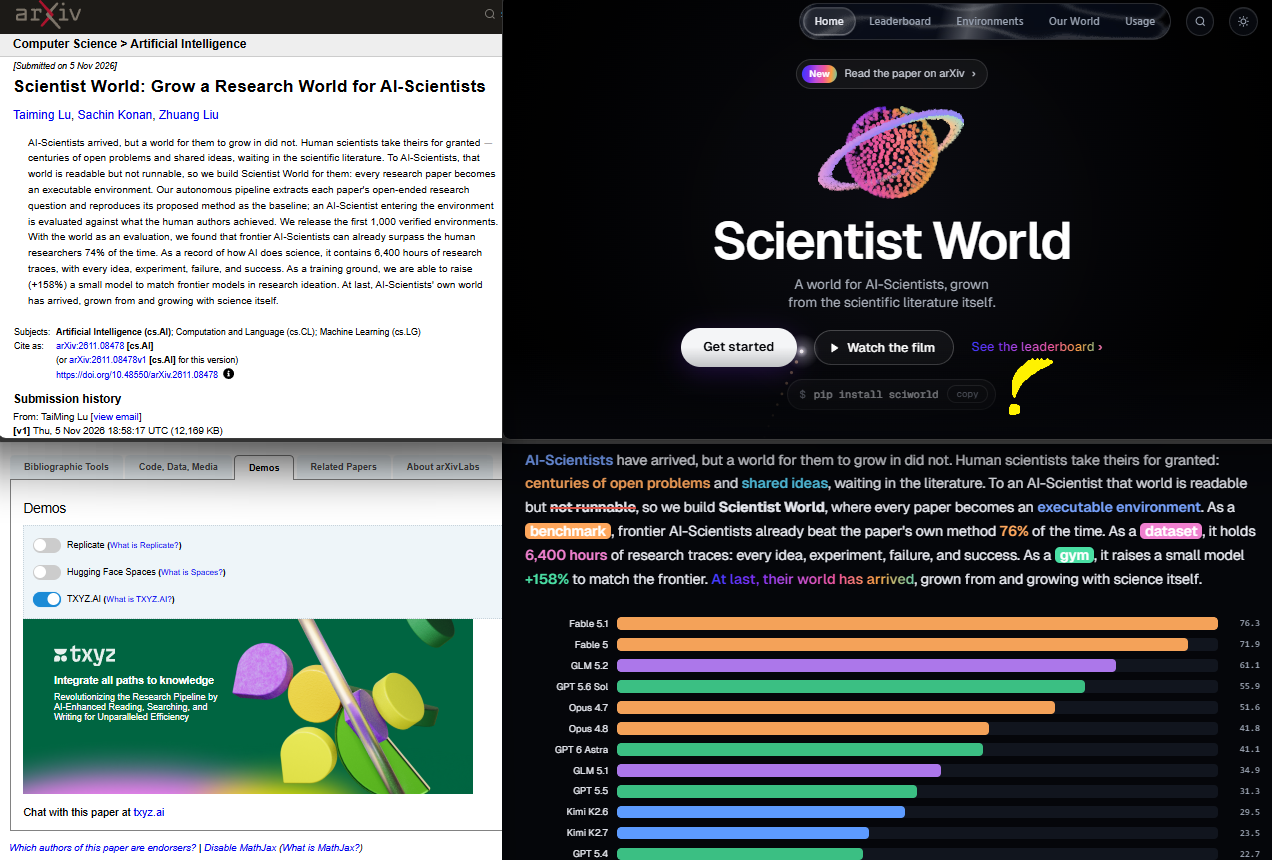
Scientist World: 1,000 papers turned into executable research environments to benchmark and train AI scientists

A Princeton team lets agents rebuild each paper as a runnable task with hidden metrics and the paper's method as baseline, then scores research agents by their gain over it. We explain the builder pipeline, the cost, the FNI score, the ten-environment benchmark behind the claim that AI scientists beat the paper 74–84% of the time, the idea-model training (41 → 106 median FNI), and why the headline needs care.

Verified4 min

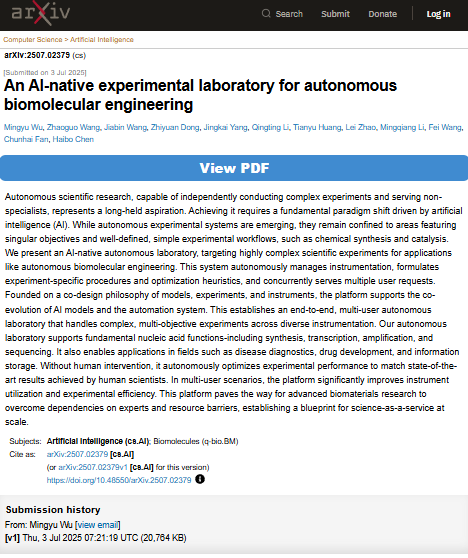
AutoDNA in Nature: LLM agents that write their own instrument drivers and schedule a shared DNA lab

A Shanghai Jiao Tong University team published AutoDNA in Nature on 5 November 2026: planner, literature, reagent, coding and execution agents run nucleic-acid experiments on 20+ instrument types, turn manuals into callable 'atomic services', and share hardware between users. Reported: ~98% stepwise synthesis yield, a full DNA data-storage cycle, ~3x throughput. We explain the architecture, compare preprint and journal numbers, and list what is missing.

Likely5 min

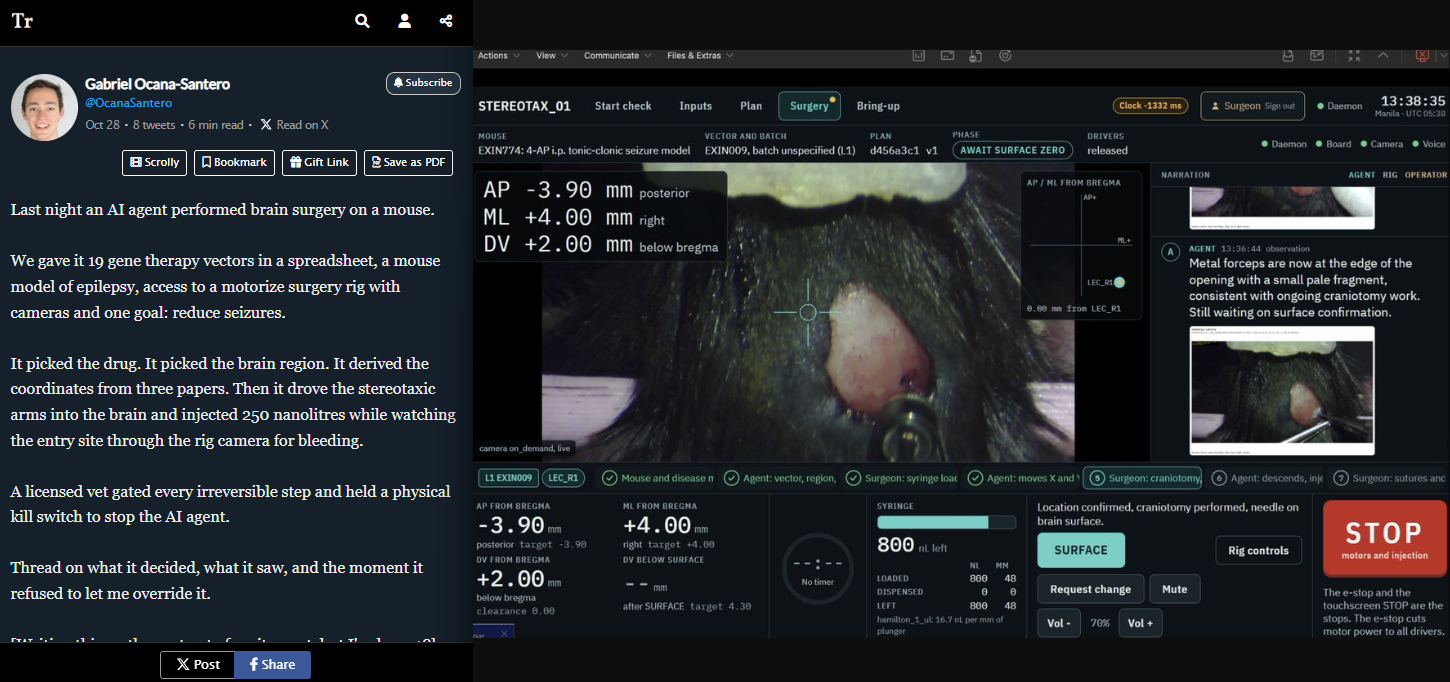
Safety gates for AI agents that control lab hardware: the Safe-SDL proposal, and an unverified agent-run mouse injection

A 27 October preprint proposes an auditable self-driving lab: a model that emits robot motions and typed instrument calls, a causal event log, and a runtime gate that checks schemas and monitors a signal-temporal-logic safety margin. No experiments yet. A self-reported X thread describes a Claude agent injecting gene therapy into a live mouse under vet supervision; it is unverified. We compare the safety designs and code a small gate.

Verified9 min

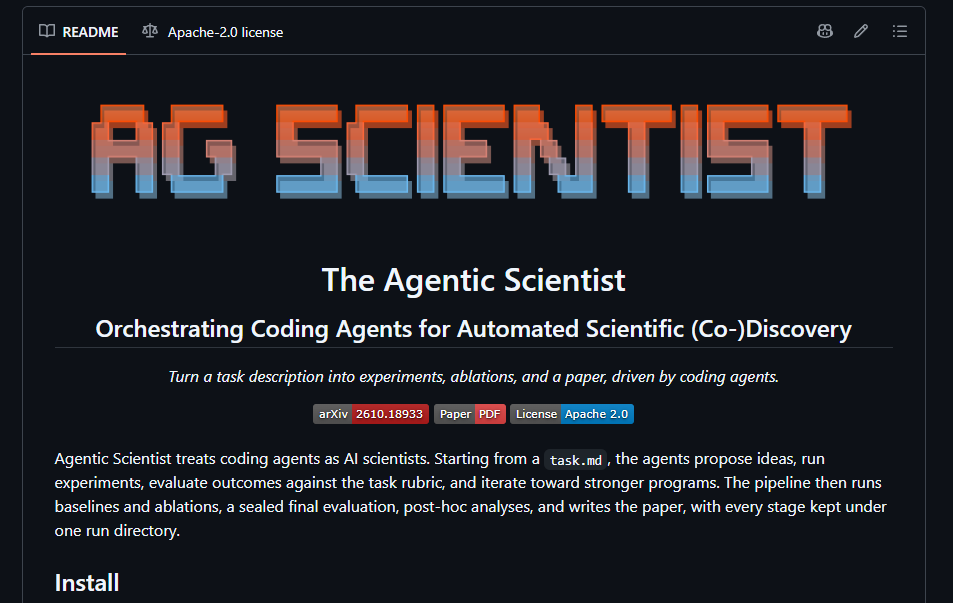
The Agentic Scientist: Sakana AI orchestrates Claude Code, Codex and other coding agents through a staged research loop

Sakana AI's successor to the AI Scientist runs coding agents in parallel through task drafting, ideation, experiments, ablations and paper writing, with rubric checks at each stage. We explain the pipeline, the 70-campaign model comparison and the case studies, and (updated 9 Nov) what the released code really does: task contract, deterministic rubrics, single-run selection, evidence checks and sandbox defaults.

Verified5 min

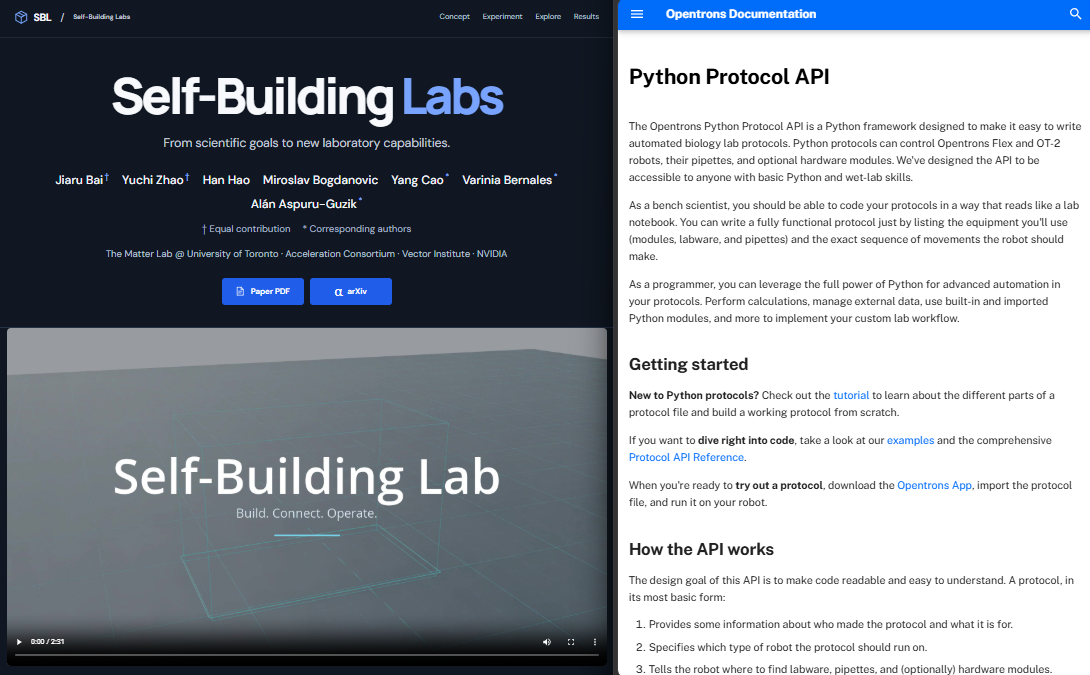
Self-Building Labs: AI agents that design, simulate and program their own self-driving chemistry lab

Aspuru-Guzik's group describes a system that turns a scientific goal into a lab layout, an Isaac Sim digital twin, robot skills and a frozen Opentrons workflow, validated with a real CdS quantum-dot synthesis. We explain the agents, the sim-to-real steps, what the paper does not report, and show how to simulate and hash-freeze a protocol yourself.