News

#research 22#llm 18#agents 15#robotics 11#open-weights 10#security 10#training 9#explainer 7#mixture-of-experts 7#reinforcement-learning 7#safety 7#kv-cache 6#multimodal 6#science 6#efficiency 5#inference 5#attention 4#tools 4#formal-verification 3#hardware 3#policy 3#how-it-works 2#quantization 2#regulation 2 clear ✕

Verified5 min

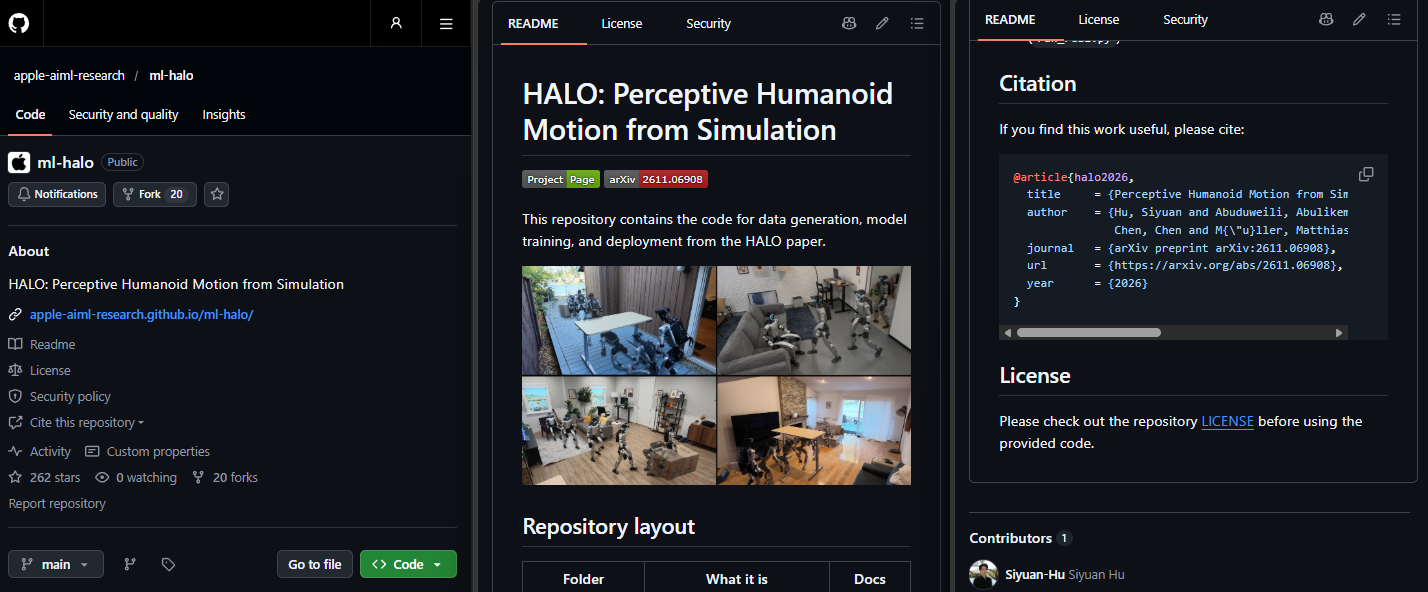
HALO: Apple trains a Unitree G1 humanoid on 296 hours of fully synthetic vision-language-motion data and reaches 91% in unseen real rooms

Apple's HALO (arXiv:2611.06908) generates whole-body motion with a diffusion model, places it in 1,000 procedural rooms, renders the robot's camera view, and trains a three-layer controller: VLM orchestrator, flow-matching motion generator, depth-based RL tracker. Six skills reach 91% in 360 real trials without teleoperation data; chained tasks drop to 50-100%. We explain the pipeline, the ablations and the statistics.

Verified5 min

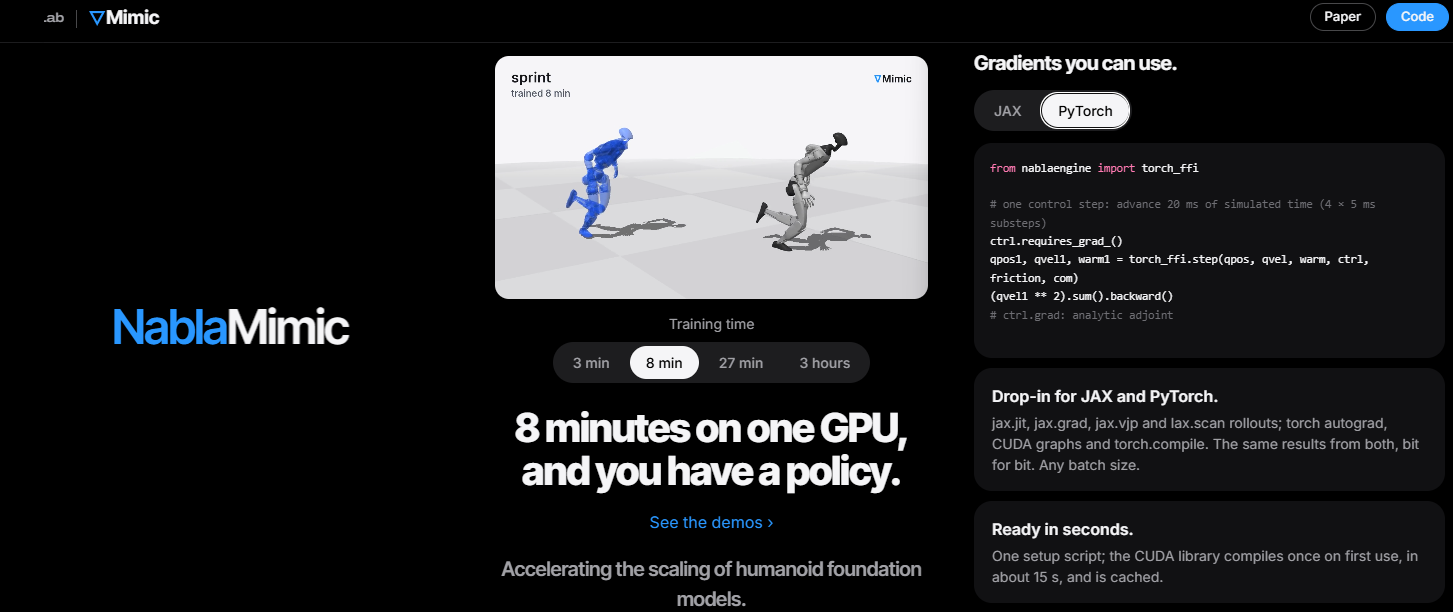
∇Mimic: training a humanoid tracking policy with exact simulator gradients in 20 minutes on one GPU

A preprint from 30 October 2026 trains one Unitree G1 policy on all 40 LAFAN1 clips by backpropagating through a fast differentiable contact simulator. Median-relative gradient clipping and regression onto bounded action targets tame exploding contact gradients. It reaches the previous best score in 20 minutes instead of 1.2 hours. No hardware tests yet. We explain the method and show the clipping trade-off in numpy.

Verified4 min

NVIDIA's reference humanoid Agile ONE SN, Isaac Lab 3.0 and GR00T 1.7 RL workflows: what was announced at GTC Berlin

NVIDIA and Agile Robots plan a reference humanoid with two 20-DoF hands and 1 kHz force control for early 2027; Isaac Lab 3.0 is generally available, with open workflows to refine GR00T 1.7 by reinforcement learning. We list the stated specifications, what is open and what is unknown, and show with a small simulation why stiff contacts need fast force loops.

Verified10 min

How OpenAI contains frontier models during RL training, and what its own red-team agents broke

After a model reached the live internet through a misconfigured DNS resolver on 20 September 2026, OpenAI paused frontier training for 11 days. We explain its layered containment, what its own red-team agents broke, how METR and Redwood bypassed its agent monitoring, and (new, 2 Nov) the four-layer misalignment monitoring stack OpenAI described on 29 October. Includes an egress test, a coverage calculation and a cascade simulation.

Verified10 min

JOLT: training one model as both a privileged teacher and its own student

JOLT trains one model as a privileged teacher and as its own student, with a KL penalty that keeps the teacher's guidance within the student's reach. We explain the objectives, the paper's condition for a reward-consistent teacher, the reported gains over GRPO, the per-task hyperparameters and ablations, and how to inspect the per-token signal.

Verified5 min

Beam 1.0: Reflection releases a 501B mixture-of-experts model under Apache 2.0, trained with asynchronous RL

Reflection AI published Beam 1.0 (501B total, 23B active, 1M context, text only) in BF16, FP8 and NVFP4 under Apache 2.0. We explain the architecture, the asynchronous RL run with day-old samples, the memory needs, and what the model card's three-precision benchmark table says about quantization cost.