Self-Building Labs: AI agents that design, simulate and program their own self-driving chemistry lab
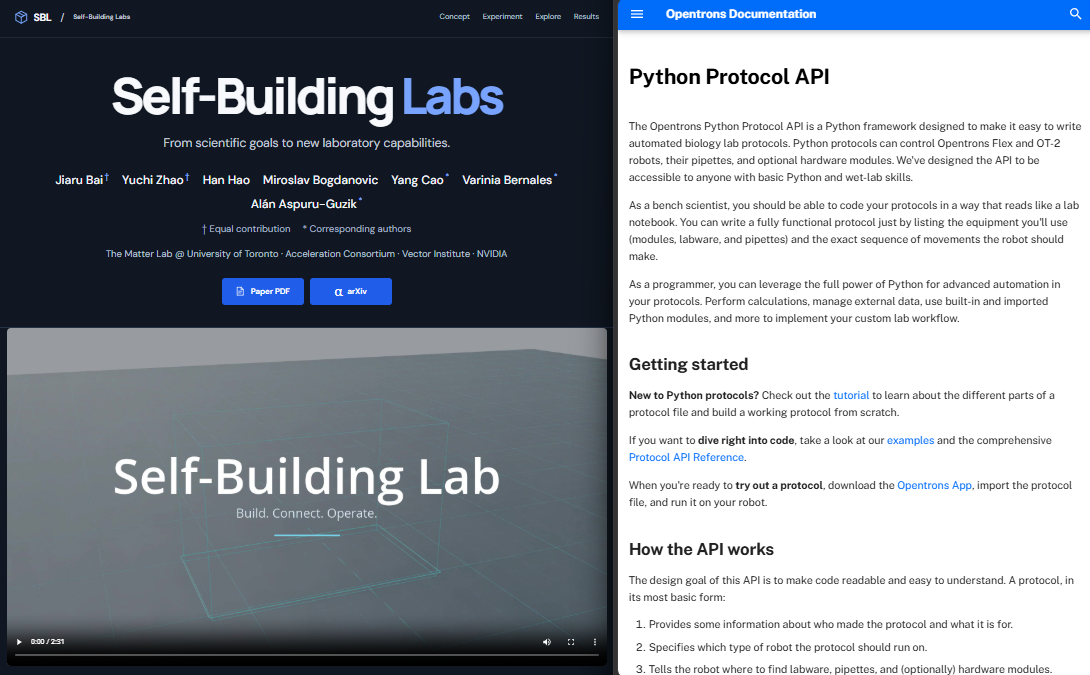
Aspuru-Guzik's group describes a system that turns a scientific goal into a lab layout, an Isaac Sim digital twin, robot skills and a frozen Opentrons workflow, validated with a real CdS quantum-dot synthesis. We explain the agents, the sim-to-real steps, what the paper does not report, and show how to simulate and hash-freeze a protocol yourself.
In short
A self-driving laboratory runs experiments on its own, but only the experiments it was built for. In "Self-Building Labs" (arXiv:2610.23826, 16 October 2026), Alán Aspuru-Guzik's group describes a system that starts from a scientific goal and builds the missing parts itself: a lab layout, a digital twin, robot skills and the experimental workflow. They validated it with a real synthesis of water-soluble CdS quantum dots on a robot arm, a pipetting robot, a plate sealer and a plate reader. The interesting part for engineers is less the chemistry and more the method: agents plan and test in simulation, then freeze what works into plain scripts with checks, and fall back to agent reasoning only when a script leaves its known conditions.
How it works
Three agents share one large language model (the paper names only "openai-gpt6-astra"):
- a scientific agent turns the goal into an experimental plan,
- a twin agent builds the digital twin, develops robot skills and tests workflows in simulation,
- a safety agent analyses scenarios in the twin and writes runtime guardrails. Every physical command passes through this layer.
The loop for each new capability is: model the equipment in simulation, plan the motion there, try it on the real robot, and, once it is repeatable, distil it into a Python script with fixed actions, sensor conditions and recovery branches. Simulated and real devices expose the same API, so the same code can target either one.
Analogy: a new lab technician first rehearses a procedure on a mock-up bench, then does it under supervision, and finally writes a checklist. After that, they only think hard when something does not match the checklist.
Under the hood
Digital twin. NVIDIA Isaac Sim 6.1 with USD scenes. The twin agent first looks for existing CAD or URDF models. If there are none, it builds approximate models from manufacturer documents and reference images with geometric primitives, and adds joints and limits for moving parts. It calibrates the twin by taking colour and depth images from planned poses with a wrist camera and adjusting object poses until rendered and real views agree. Powders are simulated as particles; liquid handling tracks volume and composition.
Skills. Grasp and place poses come from object states; collision-free trajectories come from cuRobo (GPU motion planning). Transport and coarse positioning often transferred directly from simulation. Precise steps such as grasping and insertion did not: they needed exploration on the real robot with vision, depth, joint state and a 6-axis force/torque sensor. The authors report that fine insertion became possible only after force sensing showed contact states that cameras and calibration could not.
Workflow freezing. For the quantum-dot run, the system queried the deck layout and pipette capabilities through read-only API calls, wrote an Opentrons protocol, ran it in the Opentrons simulator, and then froze it by recording its SHA-256 hash. The protocol has 236 commands and 19 robotic stages; the gateway rejects any modified version. Before execution it checks that all devices are ready and idle, and after each action that no motion is still running.
Hardware. xArm5 on a linear rail with a BIO GRIPPER G2 and a force/torque sensor; Opentrons OT-2 (8-channel P300 Gen2, single-channel P1000 Gen2); Agilent PlateLoc sealer; BioTek Cytation5 reader; Intel RealSense D435i and D405 cameras. Other demonstrations used a UR3/UR5 powder station, a mobile manipulator and an xArm liquid station; the multi-station workflow ran in simulation only.
Chemistry and result. MPA-capped CdS quantum dots from Cd(NO₃)₂ and thiourea in a 96-well plate at 60 °C. Varied factors: buffer pH 8.5–10.0, Cd:MPA ratio 1:0 to 1:2, Cd:thiourea ratio 1:1 to 1:2. Readout: absorbance at 350/400/450 nm and emission 450–680 nm (excitation 360 nm) for 8 hours. Strong emission appeared in wells G7–H9; in well H8 the emission peak moved from 520 to 560 nm, a red shift that usually indicates growing particles (our reading, not stated as a measurement in the paper). The authors report best MPA loading at 0.75–1.5 equivalents and better formation at high pH.
What is missing. The paper reports no timings, no success rates, no yields, no particle sizes and no replicate statistics. Improvement over repeated cycles was not yet measured.
Failure modes reported by the authors. Devices that failed silently without an API error; agents acting on unverified assumptions or being too cautious; disagreements between agents that needed a human; agent reasoning too slow for a timed chemical workflow (hence the frozen scripts); and the limit that twin checks only cover modelled geometry, not chemical hazards.
Try it yourself
You can rebuild the "simulate, then freeze" step without a robot. The terminal recording below shows a real session in a throw-away container (Python 3.13, opentrons 8.8.2, recorded 29 October 2026; typing speed is simulated). Note: opentrons 10.x no longer simulates OT-2 protocols, so pin version 8.8.2.
- Install the Opentrons package in a virtual environment.
- Write a small two-factor screen (3 buffer levels × 3 ligand levels in 9 wells) and save it as
qd_screen.py:
# Toy 2-factor screen on an OT-2: 3 buffer levels x 3 ligand levels, 9 wells.
# Volumes are illustrative, not the paper's recipe.
from opentrons import protocol_api

metadata = {"protocolName": "Toy quantum-dot screen"}
requirements = {"robotType": "OT-2", "apiLevel": "2.20"}

BUFFER_UL = [40, 60, 80]   # stands in for pH levels
LIGAND_UL = [0, 10, 20]    # stands in for Cd:MPA ratio

def run(protocol: protocol_api.ProtocolContext):
    tips = protocol.load_labware("opentrons_96_tiprack_300ul", 1)
    plate = protocol.load_labware("corning_96_wellplate_360ul_flat", 2)
    res = protocol.load_labware("nest_12_reservoir_15ml", 3)
    p300 = protocol.load_instrument("p300_single_gen2", "left", tip_racks=[tips])
    wells = iter(plate.wells())
    for b in BUFFER_UL:
        for l in LIGAND_UL:
            w = next(wells)
            p300.transfer(b, res["A1"], w)          # buffer
            if l:
                p300.transfer(l, res["A2"], w)      # ligand
            water = 100 - b - l
            if water:
                p300.transfer(water, res["A3"], w)  # water to 100 uL
- Run
opentrons_simulateand check the plan: 23 tip pickups are expected (9 buffer + 6 ligand + 8 water transfers; zero-volume transfers are skipped, otherwise the simulator shows a wasted tip). - Freeze the file with
sha256sumand verify it. Then change one value and verify again: the check fails, so a gateway would refuse the changed protocol.
The Python live panel shows the other idea: a distilled skill with a force limit and one retry that hands control back to the agent only when its conditions fail. With seed 0 and 200 simulated insertions it prints 94 first-try successes, 62 successes after one retry, and 44 escalations to the agent. Change the calibration error or the number of retries and watch the escalation rate move. The numbers are from a toy model, not from the paper.
Terminal
Sources
What should happen next with this?
One click per article, no account needed. “Go deeper” feeds the research queue.