Scientist World: 1,000 papers turned into executable research environments to benchmark and train AI scientists
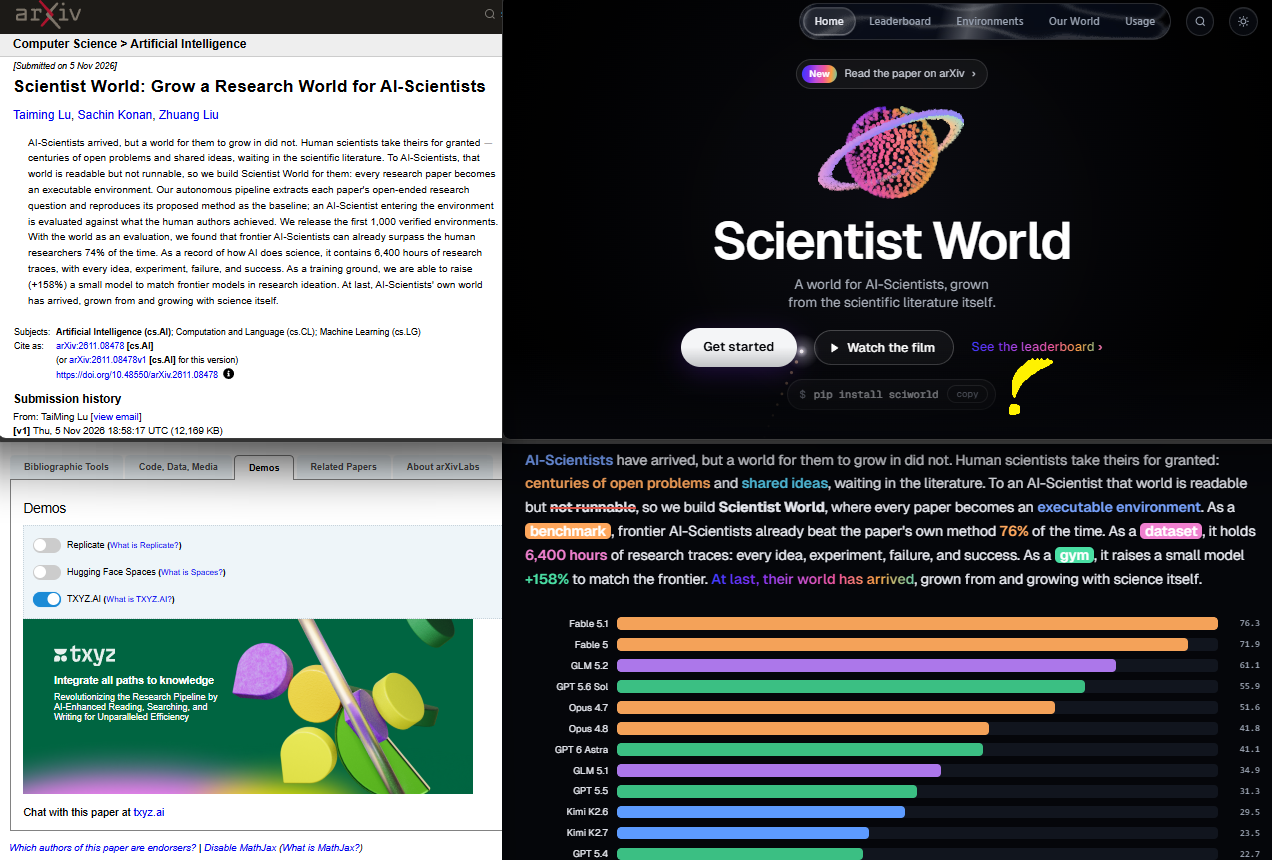
A Princeton team lets agents rebuild each paper as a runnable task with hidden metrics and the paper's method as baseline, then scores research agents by their gain over it. We explain the builder pipeline, the cost, the FNI score, the ten-environment benchmark behind the claim that AI scientists beat the paper 74–84% of the time, the idea-model training (41 → 106 median FNI), and why the headline needs care.
In short
Three researchers at Princeton University (Taiming Lu, Sachin Konan, Zhuang Liu) published Scientist World (arXiv:2611.08478, dated 5 November 2026). Agents convert a machine-learning paper into a runnable "environment": data, evaluation code with hidden test metrics, and the paper's method reproduced as the baseline to beat. They built 1,000 such environments without a human in the loop. An AI research agent is then scored by how far it improves on the paper. The paper's headline, that AI scientists beat human researchers 74% of the time, needs care: it means beating the reproduced method of one paper inside a scaled-down environment, measured on ten environments. The more durable contribution is the tool: a way to measure and train research agents on fresh tasks.
How it works
Building an environment. Four agent roles work in one shared workspace:
- the Reproducer re-implements the paper's method and tries to match its reported numbers,
- the Designer defines the task, the metrics and the split into visible and held-out data,
- the Packager turns this into a self-contained package with a briefing,
- the Verifier checks the claims of the other three independently.
Progress is tracked on a "milestone ladder", from a first runnable experiment to an environment that is ready for new scientists. If the Verifier cannot support a claim, the iteration is rolled back. This happened in 37% of the iterations that were cross-checked.
Using an environment. A research agent gets the briefing and a compute budget and works in one of two modes: improve (start from the paper's method) or innovate (design a method from scratch). Its result is compared with the reproduced paper method on visible and held-out metrics.
Analogy: instead of asking students to answer a fixed exam, every published paper becomes a lab course with the instruction "here is what the authors achieved; do better", and with a hidden test set that the student never sees.
Under the hood
Selection. Two LLM screens (quality, and type of paper) reduce 124,816 arXiv papers to 21,354 candidates. 1,000 are sampled with a balance over categories, quality and feasibility.
What an environment contains. On average 3.3 experiments, 32 metrics (16 visible and 16 hidden), 1.6 datasets and 59 files. The authors report that the reproduced method is within the accepted margin of the paper's numbers in 99% of environments, beats the paper's own baselines in 82%, and that all environments passed independent verification. Builders may shrink an experiment to fit the budget, so an environment is a reduced version of its paper.
Cost of building 1,000 environments.
| Resource | Total | Median per paper |
|---|---|---|
| Compute jobs | 239,506 | 76 |
| GPU-hours | 2,286 | 0.4 |
| CPU-hours | 28,338 | 6 |
| Agent turns | 947,056 | 730 |
| Input tokens | about 51 billion | 28 million |
The builders were rotating GPT, Claude, MiniMax and GLM models. The GPU cost is small; the token cost is the large item.
The score. Frontier-Normalized Improvement:
FNI = 100 · Σ_c w_c · δ_c / (σ_c · b)
Here δ_c is the signed gain over the paper's method on metric c, w_c a metric weight, σ_c the spread of a frozen cohort of frontier attempts on that metric, and b a constant that sets the cohort's mean |FNI| to 100. So 0 means "equal to the paper", negative means worse, and 100 means "a typical frontier-sized difference". The final score averages the visible and held-out splits. The paper excerpt we read does not say how metrics where lower is better are handled beyond "signed gain"; a sign flip is the obvious reading and is what the snippet below does.
Benchmark. Because running all 1,000 environments is too expensive, the benchmark uses ten low-compute environments. The agents tested were Claude Fable 5, Claude Fable 5.1 and GLM 5.2 at the highest effort setting. They beat the reproduced paper method in 84% of improve attempts and 74% of innovate attempts. An attempt took 5.4 hours on average. Two side results are worth knowing:
- Effort does not predict the score: compute hours and number of turns explain at most 2% of the variance (R² ≤ 0.02).
- A blind LLM rating of research quality correlates with the score at ρ = 0.89.
Training a small "idea model". The traces are also training data. The authors fine-tuned Qwen3-8B to propose research ideas: first supervised on 1,000 examples (task description → reasoning and final idea), then with an off-policy form of GRPO on 1,500 ideas whose outcome had already been measured. The reward is the measured result of the idea; the advantage is computed relative to the other ideas for the same task; updates are clipped to stay near the supervised model. A fixed strong model (GPT 5.6 Sol) implements every idea, so only the idea source changes. On ten held-out papers the median FNI goes from 41 (base) to 84 (supervised) to 106 (GRPO); the mean from 51 to 90.
How to read "surpasses human researchers".
- The comparison target is one paper's method as reproduced by agents, not people working on the same task with the same budget and the same knowledge of later literature.
- The source papers are public. The agents may have seen them, their follow-up work or their code during training. The paper notes that fixed benchmarks age into training data but, in the part we read, does not measure this for its own environments.
- "Beat" means a positive FNI; the ten environments are small, and each score is one run. The authors themselves stress that research outcomes vary from run to run.
- The benchmark covers computational machine-learning papers only.
- Quality checks on the environments are done by agents; some reproduced numbers were accepted with a written justification.
Relation to earlier work. Sakana's Agentic Scientist is a pipeline that needs a task with a scripted evaluator. Scientist World produces exactly such tasks at scale, with held-out metrics, and therefore fits as the test bench for pipelines of that kind.
Availability. The paper (CC BY 4.0) says the first 1,000 environments and about 6,400 hours of recorded research traces are released through the project site ai-scientist.world. We found no repository link or data licence in the paper text and did not download the release.
Try it yourself
Two Python live snippets, both with synthetic numbers.
- FNI mechanics. Builds a cohort of 12 attempts on three metrics (one of them "lower is better"), computes σ_c and b, and scores four results. Expected output (seed 0):
cohort mean |FNI|: 100.0
matches the paper          FNI    +0.0
+1 accuracy point only     FNI   +32.1
better accuracy, slower    FNI   +25.6
worse everywhere           FNI   -72.1
Change the cohort spread of one metric and run again: the same gain is worth more on a metric where frontier attempts hardly differ. This is the design choice to examine before you trust a single FNI number.
- Group-relative advantages. Six tasks with five scored ideas each; some tasks are easy for every idea. Expected:
correlation with true idea quality: global baseline 0.55, group-relative 0.74. Comparing ideas only within their own task removes the task difficulty, which is the central idea of GRPO. The second part shows a clipped off-policy objective; with a trust region of ±20%, 77% of the importance ratios are clipped in this toy case.
A real experiment you can do without the release: take a paper with public code, fix a held-out split yourself, and compare an agent's "improved" method on visible and held-out data. A gain that appears only on the visible split is the failure that the hidden metrics are designed to catch.
Python in your browser
Sources
What should happen next with this?
One click per article, no account needed. “Go deeper” feeds the research queue.