Safety gates for AI agents that control lab hardware: the Safe-SDL proposal, and an unverified agent-run mouse injection
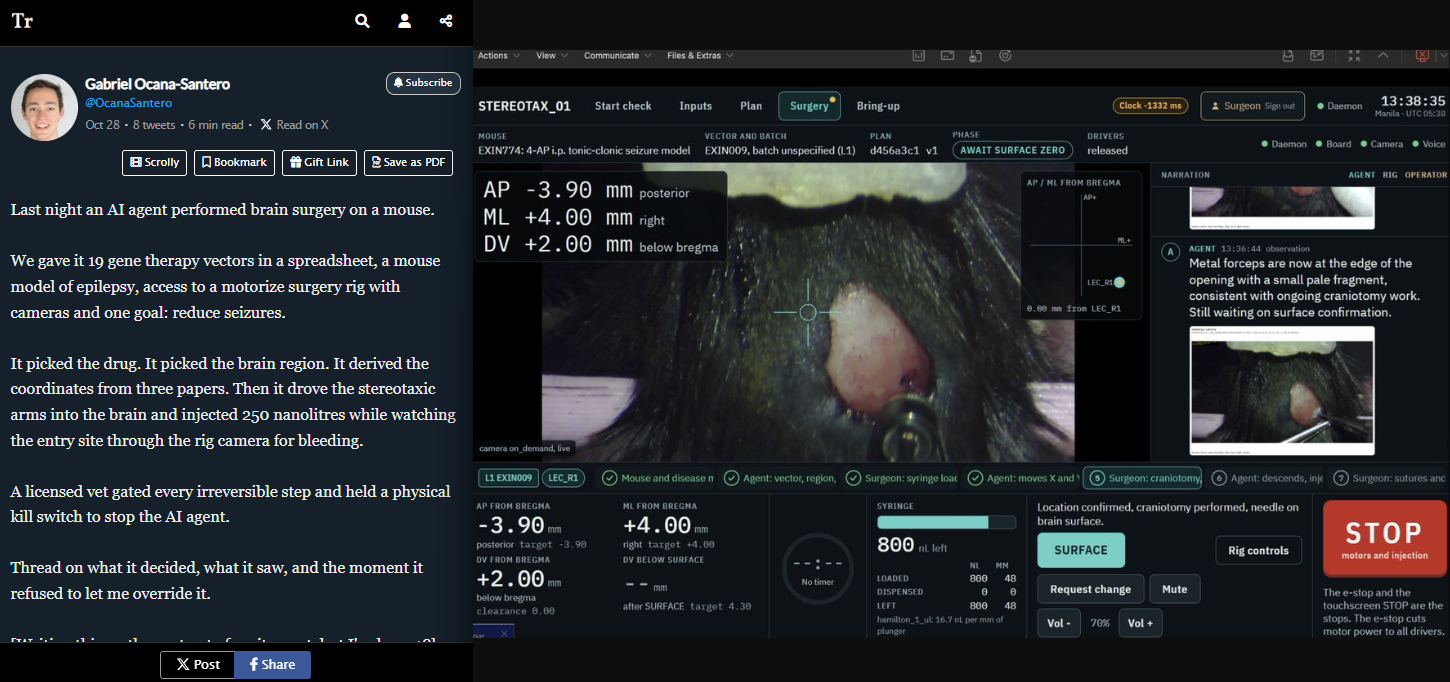
A 27 October preprint proposes an auditable self-driving lab: a model that emits robot motions and typed instrument calls, a causal event log, and a runtime gate that checks schemas and monitors a signal-temporal-logic safety margin. No experiments yet. A self-reported X thread describes a Claude agent injecting gene therapy into a live mouse under vet supervision; it is unverified. We compare the safety designs and code a small gate.
In short
AI agents are starting to control lab hardware directly, so the question is no longer only "is the plan good?" but "what stops a bad command from reaching the instrument?". A preprint from 27 October 2026, "Making Self-Driving Laboratories Auditable" (Zhang et al., arXiv:2610.36761), proposes a full stack for this: a model that outputs both robot motions and typed instrument calls, a logging layer that records every step as a causal event, and a runtime safety gate (Safe-SDL) that checks commands before dispatch and monitors temperature, force and distance during execution. It is an architecture paper: the authors report no experiments yet. In the same week, a founder posted on X (28 October) that a Claude agent planned and carried out a gene-therapy injection in a live mouse under veterinary supervision. That account is unverified and self-reported (no preprint, logs, ethics approval or outcome data), but its safety design shows the same pattern as the paper: typed limits, human approval for irreversible steps, and a physical stop button.
How it works
The paper splits a self-driving lab into four parts:
- LAM (Lab Action Model). A vision-language-action model extended so that each output contains a short robot-arm trajectory and zero or more typed instrument calls. A call names a device role (for example "heater"), an operation (Set, Execute or Read), parameters with units, timeout and retry rules, and an idempotency key so that a repeated message does not run the step twice. Instrument readings (temperature, mass, and so on) are fed back as input tokens with units, timestamps and "missing" or "stale" flags.
- OpenSDL. The execution layer that maps roles to real devices and logs every event: proposal, gate decision, dispatch, acknowledgement, completion, compensation (undo or safe-state action), each with timestamps and parent events. The idea is that you can later reconstruct why the lab did what it did.
- Safe-SDL. A gate between the model and the hardware. Before dispatch it checks the schema (types, units, ranges), reserves resources, and prevents two writers from commanding the same instrument. During execution it evaluates a formal safety rule and blocks or stops when the safety margin gets too small, when inputs are stale, or when a heartbeat is lost. Monitoring continues during long waits (reactions, cooling) even when the policy is not running.
- L3-Bench. An evaluation protocol that scores whole episodes: yield, time cost (including retries and human interventions), physical precision, and safety (violation rate, interception rate, false-positive rate, time to reach a safe state).
Analogy: the model is the chemist, Safe-SDL is the lab safety officer who checks every order form and watches the thermometer, and OpenSDL is the lab notebook that nobody can skip.
Under the hood
The safety rule. Safe-SDL expresses safety in signal temporal logic (STL), a language for conditions over time. The paper's example:
φ_safe = □[0,τ] ( T ≤ T_crit ∧ ‖F_contact‖ ≤ F_max ∧ d_vial,obs ≥ d_safe )
"Always, within the next τ seconds: temperature stays below the critical value, contact force stays below the limit, and the vial keeps a safe distance from obstacles." STL has a quantitative form called robustness: a number ρ that is positive when the rule holds and tells you by how much. Safe-SDL takes the minimum of the three normalised margins and blocks when ρ < ε. Using a margin ε > 0, not zero, means the gate acts before the hard limit is reached. The paper gives no numeric thresholds except an example heater range of 4–150 °C.
What exists and what does not. Implemented: a Rust control engine, MQTT, serial and TCP transports, ESP32 device bridges, and a SQLite log of commands, events and raw serial bytes. Proposed but not yet built or trained: the LAM itself (planned as a ~3B vision-language backbone plus a ~300M flow-matching motion expert), the full causal ledger, and all experiments. The authors list as limitations: no end-to-end training, no hardware safety validation, a log that is append-only only at application level (not tamper-evident against a privileged user), limited STL coverage, and hazards outside the formal model (sensor failure, unknown reactions) that need safe termination. A public release with schemas and simulated devices is planned; no repository link is given.
The mouse case (unverified). In a thread posted on 28 October 2026, Gabriel Ocana-Santero (who says he co-founded ExIn Therapeutics) described this setup: the agent got a spreadsheet of 19 gene-therapy vectors, a mouse epilepsy model, and an Arduino-based motorised stereotaxic rig with a camera. According to the thread, it chose a vector and a target region (lateral entorhinal cortex), averaged injection coordinates from three papers after checking they used the same depth reference, and injected 250 nL. A human surgeon did the craniotomy; a licensed veterinarian approved each irreversible step and held a physical emergency stop. The author says approvals were "hash-bound" (tied to the exact command), volumes were checked by validators, and the agent could not override these limits. He also says that after a controller desync the agent refused a move whose target was outside the rig's range. He names the models as follows: Claude Opus 5.5 refused the biology task, Opus 5 did a dry run but declined the live surgery, and Sonnet 5 carried it out. None of this can be checked: there is no preprint, protocol, ethics approval, video, agent log, or seizure outcome data, and all reports trace back to this one thread.
What the two have in common. Both put deterministic code, not the model, between the plan and the hardware: typed schemas with units and ranges, explicit approval for irreversible actions, and a stop path that does not depend on the model. The paper adds what the thread lacks: a formal runtime monitor and an audit log designed for later review. Neither replaces institutional approval; the paper says so explicitly.
Try it yourself
Two small snippets show the mechanisms. Thresholds and the heater model are invented for illustration; they are not from the paper.
- Pre-dispatch checks plus a runtime margin (first snippet). Five commands go through a schema check. Expected: 300 °C is blocked (out of range), a value in kelvin is blocked (wrong unit), a 250 µL dispense is held until a human approves it, then dispatched, and a 118 °C heater command passes. The heater is then simulated with noise, and the monitor stops it at t = 79 s when the robustness margin falls to 0.041, below ε = 0.05, at 115.1 °C, before the 120 °C limit. Note that the range check alone accepted 118 °C; only the runtime margin caught the overshoot risk. A real STL monitor would also check the predicted values over the horizon τ, not only the current value.
- Hash-bound approval (second snippet). The operator approves one exact command; its SHA-256 hash over canonical JSON is stored. The same command with keys in another order is dispatched; changing the volume or the pump rate is refused.
If you run an automated lab, a useful exercise is to list every device call your agent can make and mark which ones are irreversible. Those are the calls that need a hold-for-approval rule and a tested safe-state action.
Python in your browser
Sources
What should happen next with this?
One click per article, no account needed. “Go deeper” feeds the research queue.