Humanoids in factories, October 2026: Korea's sandbox test, Neura's RoboGym, Hyundai's 2032 horizon and AgiBot's Worken metric
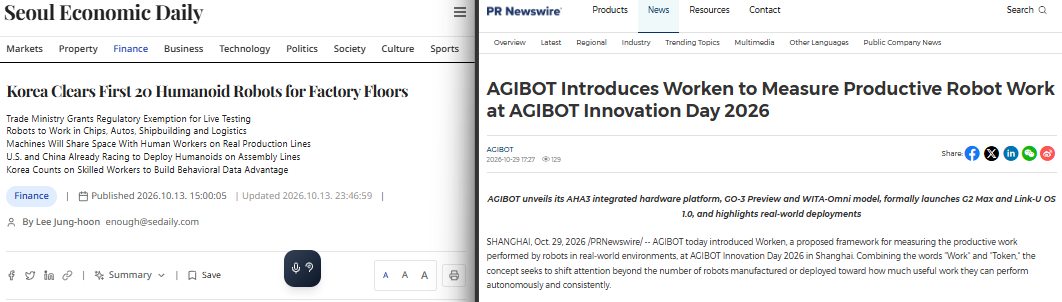
Korea approved 20 Robros humanoids for work next to people, Neura and TUM opened a 17-million-euro training centre, Hyundai put humanoids in new plants after 2032, and AgiBot proposed a metric for autonomous robot work. We explain the safety-rule bottleneck, how real-task training data is collected, the Worken formula and its weaknesses, and what is still not measured.
In short
In October 2026 several steps moved humanoid robots closer to real production work. South Korea granted a regulatory exemption for 20 Robros humanoids to work next to people at four companies (13 October). Neura Robotics and the Technical University of Munich opened a €17 million robot training centre, the TUM RoboGym, and showed the 4NE1 Gen 4 humanoid (28 October). Hyundai Motor Group said humanoids will come to its new plants only after 2032 (18 October). AgiBot proposed a metric, the "Worken", to count useful autonomous robot work instead of robots sold (29 October). Together they show where the real bottlenecks are: safety rules, training data from real tasks, and honest measurement.
How it works
Safety rules. Today's industrial robot standards assume a fixed machine behind a fence. A walking humanoid that shares space with workers does not fit that model. Korea's Ministry of Trade, Industry and Energy therefore approved a sandbox exemption so that test data can be collected and safety standards revised. The planned tasks are concrete: cleaning contaminants from round parts in semiconductor back-end packaging (Nepes), placing car-body parts (Sungwoo Hitech), stacking scaffolding brackets for ship hulls (HD Hyundai Samho) and moving refrigerated packaging (Delivery Lab).
Training on real tasks. The TUM RoboGym (2,300 m² near Munich Airport, built with TUM's robotics institute MIRMI) lets companies bring their own tasks, such as handling boxes, filling bottles or loading wooden parts. Data comes from three sources: real robot operation, human demonstrations recorded with sensor suits, motion capture and teleoperation, and simulation whose variations are checked on real robots.
Measuring useful work. AgiBot's proposal:
Worken = number of active robots × autonomous working hours × output efficiency ratio
"Active" means robots doing tasks in real environments, not units shipped. "Autonomous hours" excludes teleoperated and idle powered-on time. The output efficiency ratio compares output with a reference, such as what a human worker produces under established standards. Analogy: counting how many cars a taxi company owns tells you less than counting paid kilometres driven without a backup driver.
Under the hood
What we know about the hardware.
| System | Stated facts | Source type |
|---|---|---|
| Robros humanoids (Korea test) | 20 bipedal units at 4 sites, working next to or near humans; no end date given | Korean press report of the ministry decision |
| Neura 4NE1 Gen 4 | 20% lighter than its predecessor, sensorised textile skin, new hands; "Neuron AI" model combines vision, touch, force and sound; prepared for series production | Company statements via trade press |
| AgiBot G2 Max | 21 degrees of freedom, dual-arm handling up to 40 kg, working height 0.1–2.5 m | Company press release |
Investment and timelines. The RoboGym costs about €17 million (about €11 million from Neura) and is planned for three years as the first site of a "Neura Gym" network; a second German site with RWTH Aachen is in development. Hyundai plans to develop autonomous manufacturing at its Singapore innovation centre (HMGICS) by 2030, with humanoids and full automation at new factories after 2032, according to the head of its E-FOREST centre.
Reference numbers from the Korean report. BMW's Spartanburg plant used a Figure 02 robot for about 10 months, handling more than 90,000 parts for over 30,000 X3 vehicles; Shanghai aims for 8,000 factory humanoids by 2028; Korea installed 30,200 new industrial robots in 2025 versus 354,200 in China (IFR figures as quoted). We could not check these figures against their original sources.
Weak points of the Worken metric.
- It is a product of three factors, so a 10% change in any one factor changes the result by 10%. A large fleet with little autonomy can score the same as a small fleet that works all day.
- The output ratio depends entirely on the chosen human reference. A stricter reference lowers the score without any change to the robot. AgiBot says task-specific benchmarks are still to come.
- It does not count quality defects, safety incidents, interventions per hour or energy use. AgiBot calls Worken "an evolving framework", and no public data set uses it yet.
What is not known. None of the four announcements gives success rates, intervention rates or mean time between failures for humanoids in production. The Korean test has no published end date or evaluation criteria.
Try it yourself
The Python live panel implements Worken with made-up numbers (standard library only). Expected output:
A: many robots, often teleoperated        133.3 worken per day
B: few robots, long autonomy              210.0 worken per day
B with a stricter human reference         140.0 worken per day
+10% robots         -> +10%
+10% autonomous_h   -> +10%
+10% output_per_h   -> +10%
Fleet B (20 robots) beats fleet A (100 robots) because it works autonomously for 14 hours instead of 2. Changing only the human reference from 60 to 90 units per hour drops fleet B by a third. Try adding a factor for interventions per hour or defect rate and see how the ranking changes; that is the kind of field a fair industry metric would need.
Python in your browser
Sources
- Seoul Economic Daily: Korea clears first factory test of 20 humanoid robots (13 Oct 2026)
- AgiBot Innovation Day 2026 press release (Worken, G2 Max, GO-3)
- Robotics & Automation News: Neura and TUM open RoboGym (28 Oct 2026)
- Aju Press: Hyundai to deploy humanoids at new factories after 2032 (18 Oct 2026)
What should happen next with this?
One click per article, no account needed. “Go deeper” feeds the research queue.