Inkling 2 Mini: a 26B mixture-of-experts model that runs its middle layers three times
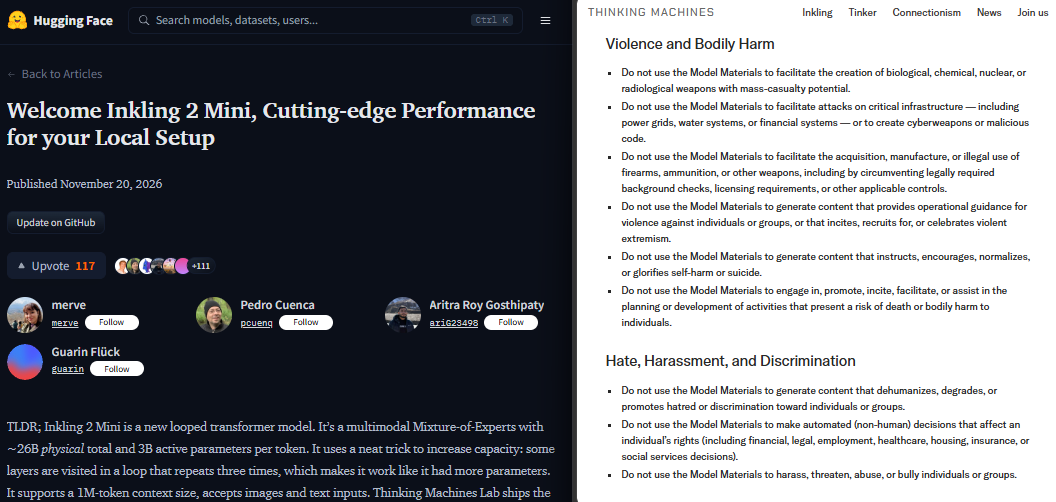
Thinking Machines Lab released Inkling 2 Mini (26.4B total, 3.4B active, 1M context, text and images). Layers 6–17 run three times with shared weights, giving 48 layer visits per token. We explain the loop, the sliding-window/full-attention mix, why the loop doubles the long-context KV cache (about 4.2 GiB at 128k in 16-bit), the vendor benchmarks, and the Apache-2.0 tag plus binding use policy.
Fact sheet
- Model
- Inkling 2 Mini
- Vendor
- Thinking Machines Lab
- Parameters
- 26.4B total, 3.4B active (128 experts, 8 active); 48 layer visits
- Context
- up to 1,048,576 tokens
- Released
- 2026-11
- Licence
- Open weights · restricted licence Apache-2.0 (model card tag) plus binding Model Acceptable Use Policy
| Benchmark | Result | Provenance & comparison | Source |
|---|---|---|---|
| SWE-bench Verifiedbash only; card lists Qwen3.8-27B at 77.8 | 79.2 % | Self-reported | source ↗ |
| BrowseCompwith compaction | 79.0 % | Self-reported | source ↗ |
| LongBench v2settings not stated | 66.9 % | Self-reported | source ↗ |
| MRCR v28 needles, 256K–512K context | 46.4 % | Self-reported | source ↗ |
Self-reported numbers come from the vendor itself, often with its own prompts and settings. Treat them as claims until independent or reproduced results exist.
In short
Thinking Machines Lab released Inkling 2 Mini on 20 November 2026: a mixture-of-experts model with 26.4B total and 3.4B active parameters, text and image input, and up to 1M tokens of context. Its unusual feature is a loop: the middle 12 of its 24 decoder layers run three times with the same weights, so each token passes through 48 layer visits. The model card tags the weights Apache-2.0, but downloading them also binds users to the company's Model Acceptable Use Policy. Vendor benchmarks put it close to Qwen3.8-27B with far fewer active parameters.
How it works
Looping. A normal transformer has a stack of different layers, and each token passes through each layer once. Inkling 2 Mini runs layers 0–5 once, then the "core" layers 6–17 three times, then layers 18–23 once. The blog says the reuse makes the model work as if it had more parameters, while only one copy of the core weights is stored. Between passes, each looped layer can read the previous pass's output through a learned query, and a small gated controller (rank 64) decides how much of this "message" to mix in.
Analogy: instead of 48 different editors each reading a draft once, 12 of the editors read the draft three times and leave notes for their next reading.
Mostly local attention. In each block of six layers, five use sliding-window attention over the last 1,024 tokens and one uses full attention. Positions come from learned relative-position logits instead of rotary embeddings. Full-attention layers add dynamic convolutions on keys and values, and every layer keeps a short convolution (kernel 4).
Mixture of experts. Each MLP has 128 routed experts, 8 used per token, no shared expert, expert width 1,152.
Under the hood
From the config.json (text_config): 24 layers, hidden size 2,304, 24 query heads and 8 KV heads of dimension 128 (grouped-query attention), sliding_window_size 1,024, local_layer_ids lists 20 sliding-window layers (so layers 5, 11, 17 and 23 are full attention), loop_config with core_start 6, core_end 18, num_passes 3. The context limit appears as model_max_length 1,048,576. The weights ship in NVFP4 (ModelOpt) with MXFP8 parts. A 3-layer drafter for speculative decoding ("DSpark", block size 8) reads hidden states from visits 5, 23, 41 and 48.
KV cache – the cost of the loop. The blog states that each visit keeps its own KV cache. Counting visits: 48 in total, of which 8 are full attention (layer 5 once, layers 11 and 17 three times each, layer 23 once) and 40 sliding window. With 16-bit keys and values one visit stores 2 × 8 × 128 × 2 = 4,096 bytes per token. Our estimate:
| Context | KV cache (looped, 48 visits) | Same layers without loop |
|---|---|---|
| 8k tokens | 0.41 GiB | 0.20 GiB |
| 128k tokens | 4.16 GiB | 2.08 GiB |
| 1M tokens | 32.16 GiB | 16.08 GiB |
So the loop doubles the long-context cache, because the two looped full-attention layers count three times. The sliding-window part stays at 160 MiB whatever the context. These are our calculations from the config (short-convolution state, cross-pass messages and the drafter are not counted; runtimes may store KV in 8 bits). The values are available as a preset in the KV-cache calculator.
Compute. The card gives 5.4B "effective active" parameters per token with three passes (about +1.0B per extra pass). A research variant, TML-d24-varloop-research, accepts 1 or 2 passes for faster inference; the blog says quality may be slightly lower and that it has not been evaluated in depth.
Licence. The Hugging Face metadata says Apache-2.0, but the repository has no LICENSE file. The Model Acceptable Use Policy (updated 15 July 2026) says that accessing, downloading or using the model materials binds you to it. It lists prohibited uses (for example weapons, cyberweapons, automated decisions affecting people's rights, unlicensed professional advice without oversight), requires disclosure to end users that they talk to an AI where required, and can change at any time. We found no size or revenue caps. Because of the binding policy we classify the weights as open-restricted, not permissive.
Benchmarks. All figures below are from the vendor's model card; the comparison model (Qwen3.8-27B) was also reported there, and settings beyond the row labels (reasoning effort, sampling) are not stated. The blog claims a lead in 32 of 48 benchmarks against four models; we did not check this count.
| Benchmark (card label) | Inkling 2 Mini | Qwen3.8-27B |
|---|---|---|
| SWE-bench Verified, bash only | 79.2% | 77.8% |
| Terminal Bench v2.1 (in pi v0.83.0) | 71.6% | 73.0% |
| BrowseComp, with compaction | 79.0% | 61.6% |
| LongBench v2 | 66.9% | 52.3% |
| MRCR v2, 8 needles, 256K–512K | 46.4% | 38.0% |
| MMMU Pro (Standard 10) | 74.9% | 76.3% |
Try it yourself
The Python live panel has two snippets:
- KV-cache count. It rebuilds the 48 visits from the config values and prints the table above. Expected output:
48 (full attention 8, sliding window 40),4096 bytesper visit, then 0.41 / 4.16 / 32.16 GiB for 8k / 128k / 1M tokens. Changepassesto 1 to see the variable-loop model's cache. - Compute and attention reads. It prints effective active parameters for 1–3 passes and how many megabytes of KV the attention reads per generated token. Expected output: about 302 MB at 4k context, 2,315 MB at 64k and 17,348 MB at 512k; the sliding-window share falls from 56% to 1%, so at long context the 8 full-attention visits dominate decoding speed.
To run the model, the blog lists (we have not run these; no versions are pinned in the blog):
# llama.cpp, 4-bit GGUF
llama serve -hf ggml-org/Inkling-2-Mini-GGUF:IQ4_NL
# vLLM (model card)
pip install vllm
vllm serve thinkingmachines/Inkling-2-Mini
The blog says its SGLang command needs an SM103 GPU (Blackwell Ultra). Check the model card for current requirements.
Python in your browser
Play with it
Sources
What should happen next with this?
One click per article, no account needed. “Go deeper” feeds the research queue.