GR00T 2: NVIDIA's 2B world action model predicts video and robot actions in one pass, with a Turbo variant that runs on board a humanoid
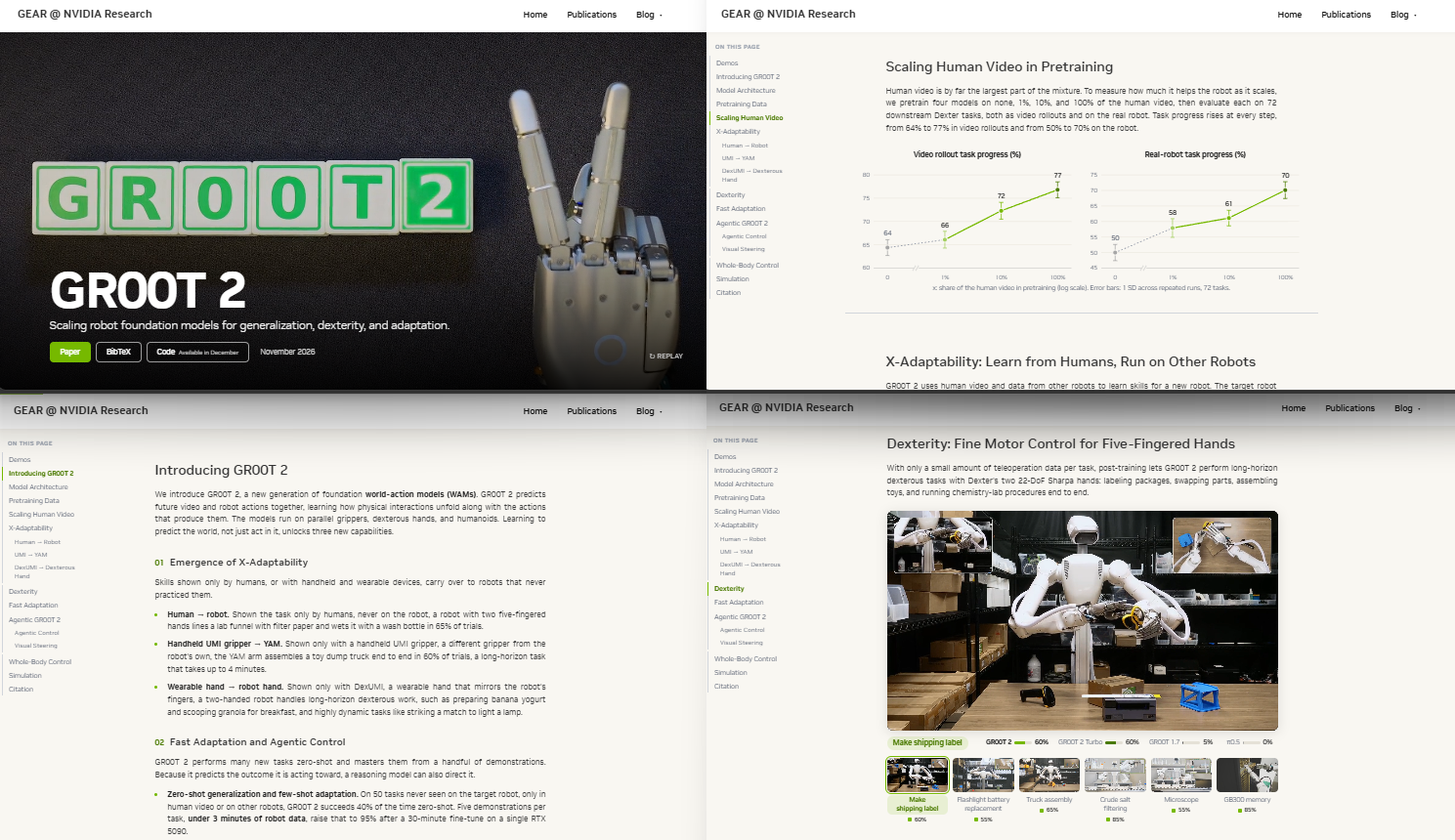
NVIDIA presented GR00T 2 at CoRL 2026: a 2B-parameter transformer built on Cosmos that denoises future camera frames and an action chunk together. We explain the architecture, the 400,000 hours of human video behind it, the Turbo variant (124 ms on a Jetson AGX Thor), the reported few-shot results and the stated limits. Code is announced for December; no licence yet.
Fact sheet
- Model
- GR00T 2 / GR00T 2 Turbo
- Vendor
- NVIDIA
- Parameters
- 2B (joint video-action transformer)
- Released
- announced 2026-11; code due 2026-12
- Licence
- Licence unknown not published yet (model not released)
| Benchmark | Result | Provenance & comparison | Source |
|---|---|---|---|
| YAM long-horizon tasks, successreal robot; Turbo 65.0; baselines post-trained by NVIDIA | 71.7 % | Self-reported | source ↗ |
| Dexter-50, 5 demonstrations per taskLoRA fine-tune; zero-shot 40, one-shot 71 | 95 % | Self-reported | source ↗ |
| RoboCasa365simulation; leaderboard as of 6 Nov 2026 | 67.2 % | Self-reported | source ↗ |
| Turbo latency on Jetson AGX ThorUnitree G1, per 1.6 s action chunk | 124 ms | Self-reported | source ↗ |
Self-reported numbers come from the vendor itself, often with its own prompts and settings. Treat them as claims until independent or reproduced results exist.
In short
At the Conference on Robot Learning (CoRL) in Austin on 9 November 2026, NVIDIA presented GR00T 2, a 2-billion-parameter robot model that predicts the next camera frames and the next robot actions together. NVIDIA calls this a world action model. A smaller-token version, GR00T 2 Turbo, runs on the computer inside a Unitree G1 humanoid in 124 ms per prediction. The whitepaper reports that a new two-handed robot reaches 95% average success on 50 tasks after only five demonstrations per task. The model is not downloadable yet: the project page says "Code Available in December", and no licence has been published. All numbers below are NVIDIA's own.
How it works
A classic vision-language-action (VLA) model maps images and an instruction directly to motor commands. GR00T 2 starts from a video generation model (NVIDIA Cosmos) and adds actions to it. In one pass it produces two things: a short video of what the cameras should see next, and the chunk of actions that makes this happen. The robot executes the actions, looks again, and the model plans the next chunk.
Why predict video at all? Video of people working exists in very large amounts, while robot data is scarce. A model that must predict what happens next in human video learns how objects move, and this knowledge is reused when it predicts robot actions. More than 90% of the hours in the training mixture are video of people, not robot data.
Analogy: a cook who first imagines how the next seconds should look (the egg slides into the pan) and then moves the hands so that this picture becomes true.
For long tasks, a second system sits above the model: a reasoning agent (a large language model) that looks at the scene, splits the job into steps, and tells GR00T 2 what to do next. It can also point: it marks a grasp point and a release point on the camera image, and GR00T 2 was trained to follow such marks.
Under the hood
Architecture (whitepaper, section 2).
- One transformer with 2B parameters, initialised from the video diffusion model Cosmos-Predict2.5-2B. Video, robot state and action tokens form a single sequence.
- Video is compressed by a frozen Wan 2.1 VAE (4× in time, 8× per spatial dimension) and cut into 280 tokens per latent frame and camera at 224×320 pixels. This matches 2×2 latent patches (28×40 latents → 14×20 tokens; the patch size is our inference, the paper states only the token count).
- The instruction is encoded by a frozen Cosmos-Reason1 vision-language model and read through cross-attention.
- Small robot-specific MLPs map the robot state and the noisy action chunk into the transformer, and a robot-specific decoder maps tokens back to actions. Everything else is shared across robots.
- Action tokens attend to all video tokens, including the future frames that are being generated. This is the technical core: the action is conditioned on the imagined future.
- Input per control step: 0.8 s of history at 5 frames per second from up to four cameras, robot state and the instruction.
Training. The objective is flow matching with one loss on future video latents and one on actions. The action loss is applied only where action labels exist; for human video the labels are tracked hand poses. Pretraining has three stages: single-view video, then multi-view video plus actions, then the same with robot data weighted up. The main run used 1,024 GPUs of a GB300 NVL72 cluster. Total training time, optimiser settings and loss weights are not stated.
| Data source | Amount |
|---|---|
| Egocentric video of people working (Human-1M, filtered) | 402,730 h |
| Handheld gripper demonstrations (UMI-10K) | 10,184 h, 2,897 tasks |
| Robot teleoperation (YAM arms, Sharpa and Wuji hands, Unitree G1, Franka) | about 23,500 h |
| In-lab human data aligned to robot setups | 3,000 h |
Inference. In deployment the model uses one or two denoising steps for video and two to four for actions. Turbo uses one video step and two action steps.
| Setting | Latency per action chunk |
|---|---|
| GR00T 2, three cameras, RTX 5090 | 153 ms (median) |
| GR00T 2, DGX Station GB300 | 48–54 ms |
| Turbo on Unitree G1, RTX 5090 | 38 ms |
| Turbo on Unitree G1, Jetson AGX Thor (on board) | 124 ms |
Turbo. Turbo replaces the VAE with Wan 2.2, which compresses 16× per spatial dimension, so each frame costs 70 tokens instead of 280. The transformer stays at 2B parameters. On the G1 it plans 1.6-second chunks about once per second; a separate whole-body controller (SONIC) turns them into joint targets at 50 Hz. The price is accuracy: Turbo reaches 65.0% instead of 71.7% success on the arm benchmark, and 34.3% instead of 68.6% on the dexterous-hand benchmark. The authors say this comparison does not isolate the cause.
Results reported by NVIDIA (all self-reported).
| Test | GR00T 2 | Comparison |
|---|---|---|
| YAM arms, long-horizon tasks, success | 71.7% | π0.5 12.5%, GR00T 1.7 8.3% |
| Dexterous hands, long-horizon tasks, success | 68.6% | GR00T 1.7 0.7%, π0.5 0.0% |
| New two-hand robot "Dexter", 50 tasks, no robot-specific data | 40% | — |
| Same, 1 demonstration per task | 71% | — |
| Same, 5 demonstrations per task (LoRA, about 30 min on one RTX 5090) | 95% | — |
| RoboCasa365 (simulation) | 67.2% | 2.8 points above the previous best entry |
| Blind A/B comparisons (6,035 comparisons) | +236 Elo over π0.5 | about 80% win rate |
The baselines were post-trained by NVIDIA, not by their authors, so treat the gaps as an upper estimate. Leaderboard positions are as of 6 November 2026.
Does human video help? In an ablation, real-robot success rises from 18% with no human video to 41% with all of it (27% at 1%, 28% at 10%).
Reinforcement learning on top. After supervised fine-tuning, a self-imitation method based on GRPO (group-relative policy optimisation) raises four contact-rich real tasks from 40–76% to 88–98% (50 trials each).
The agent layer. The reasoning agent calls GR00T 2 through tool calls (for example wam_act, stop_wam, get_image). With grasp and release marks on the image, short tasks rise from 35.7% to 76.8% and long tasks from 0.0% to 53.3%. A method called ASPIRE finds task programs in simulation that combine model calls with classical perception and motion planning; with it, toy assembly reaches 97–98 successes in 100 cluttered trials, against 23–69 without.
Limits stated by the authors.
- GR00T 2 sees only 0.8 s of history. Anything that needs memory is left to the agent.
- Touch and force are not inputs. How to add them is called open.
- Marks on the image cannot say how an object should be oriented, or describe pouring and scooping.
- Three of eight failures in long assembly were screws left partly driven that both the model and the agent judged as finished. Checking small physical details is unsolved.
- Real-robot success rates come from a few dozen trials each, so the intervals are wide (see the snippet below).
What is available now. The whitepaper, a 100,000-hour part of the human video dataset (Human-1M-100K on Hugging Face) and hardware designs for the handheld grippers. Isaac Lab 3.0 is open source. For the model, the project page says only "Code Available in December"; Humanoids Daily reports that weights for both variants are also planned for December 2026. No licence text exists yet, so we classify the licence as unknown.
Try it yourself
The model cannot be run today. The three Python live snippets test the numbers and the idea.
- Token budget. Reproduces 280 and 70 tokens per frame from the compression factors, and shows that a 4× smaller token count gives a 16× smaller attention cost. Expected first lines:
GR00T 2 : 280 tokens per latent frame and cameraandGR00T 2 Turbo: 70 tokens per latent frame and camera. - Flow matching with few steps. Samples a two-mode "action" distribution with the exact velocity field and 1, 2, 4, 10 or 50 Euler steps. Expected output (seed 0):
  1 steps: W1 distance to target 1.683, share in left mode 0.00
  2 steps: W1 distance to target 0.638, share in left mode 0.36
  4 steps: W1 distance to target 0.314, share in left mode 0.36
 10 steps: W1 distance to target 0.136, share in left mode 0.39
 50 steps: W1 distance to target 0.048, share in left mode 0.39
One step collapses both modes into their average, which for a robot means a motion between two valid options. Two to four steps already find both modes with the right weights (target: 0.40). This is why deployment uses two to four action steps and not one.
- How sure is "48 of 48"? Wilson intervals for the reported trial counts, and the conversion from Elo gap to win rate. Expected:
48/48 -> 95% interval 92.6% to 100.0%,9/10 -> 95% interval 59.6% to 98.2%, andElo gap 236 -> win rate 79.6%, which matches the "about 80%" in the whitepaper.
For background on the two model families, see our explainer on vision-language-action versus world-action models.
Python in your browser
Sources
What should happen next with this?
One click per article, no account needed. “Go deeper” feeds the research queue.