ScaleVLA: a robot policy on a frozen 552B mixture-of-experts backbone
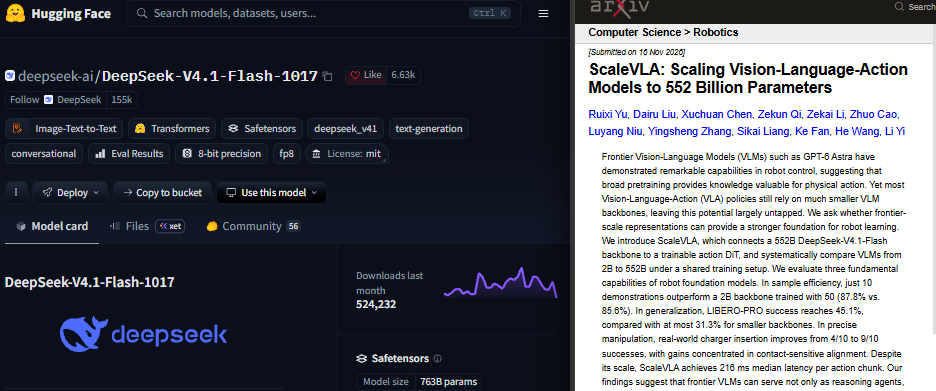
Researchers from Tsinghua, Peking University, SJTU and Galbot attached a GR00T-style flow-matching action head to the frozen 552B DeepSeek-V4.1-Flash-1017 model. They report gains over 2B–32B backbones on LIBERO, LIBERO-PRO, RoboCasa and DexJoCo, largest with 5–10 demonstrations, at 216 ms per action chunk on four H200 GPUs. We explain the design, the numbers and what is missing.
Fact sheet
- Model
- ScaleVLA
- Vendor
- Tsinghua University, Peking University, Shanghai Jiao Tong University, Galbot
- Parameters
- 552B MoE backbone (frozen, 20 layers used) + 32-layer DiT action head
- Released
- 2026-11
- Licence
- Licence unknown No weights found; paper CC BY 4.0; code repository licence not checked
| Benchmark | Result | Provenance & comparison | Source |
|---|---|---|---|
| LIBERO (average of 4 suites)Table 2; best dense baseline 94.0 (Cosmos-R2-32B, same action head) | 96.1 % | Self-reported | source ↗ |
| LIBERO-PRO (mean)Table 3; evaluation only, no retraining | 45.1 % | Self-reported | source ↗ |
| Latency per action chunkmedian, 4x H200, 4 flow steps; 2B baseline 114.7 ms on 1 GPU | 215.8 ms | Self-reported | source ↗ |
Self-reported numbers come from the vendor itself, often with its own prompts and settings. Treat them as claims until independent or reproduced results exist.
In short
A group from Tsinghua University, Peking University, Shanghai Jiao Tong University and the robot company Galbot posted ScaleVLA on arXiv on 16 November 2026. It connects a robot action head to the frozen 552B-parameter mixture-of-experts language model DeepSeek-V4.1-Flash-1017, which makes it by far the largest backbone reported for a vision-language-action (VLA) model. The authors report better results than 2B–32B dense backbones on four simulation benchmarks and one real two-arm task, with the largest gains when only 5–10 demonstrations are available. Latency per action chunk rises only from 115 ms to 216 ms, but the big model needs four H200 GPUs instead of one.
How it works
A VLA model reads camera images, a text instruction and the robot state, and outputs the next robot motions. Most VLAs use a small vision-language model (about 2–8B parameters) so that they run fast on one GPU. ScaleVLA asks a simple question: what happens if the backbone is a very large sparse model, where only a small part of the weights is used per token?
The design has two parts:
- A frozen backbone that only reads. The images, instruction and state are turned into tokens and passed through the first 20 layers of DeepSeek-V4.1-Flash-1017 (the "causal encoder" in the paper's words). No text is generated. The backbone weights are not trained; only its hidden states (width 5120) are used as features.
- A trained action head. A head in the style of NVIDIA's GR00T N1.7 turns these features into a chunk of future actions. It has a feature adapter (5120 → 2048 plus four self-attention layers), small networks that embed the robot's state and actions per robot type, and a 32-layer diffusion transformer that alternates self-attention and cross-attention to the backbone features. It is trained with flow matching: it learns a velocity that moves random noise step by step towards a realistic action chunk.
Analogy: the backbone is a very experienced observer who describes the scene once; the action head is a smaller specialist who turns that description into hand motions in a few quick drafts.
Under the hood
Sampling cost. The backbone runs once per action chunk. The action head then runs 4 flow steps. A chunk is 16 steps long on LIBERO (8 executed before re-planning) and 30 steps on DexJoCo.
Results reported by the authors (all self-reported; the dense baselines were trained by the same authors with the same action head):
| Benchmark | ScaleVLA | Best dense backbone (2B–32B) |
|---|---|---|
| LIBERO, average of 4 suites | 96.1% | 94.0% (Cosmos-R2-32B) |
| LIBERO-PRO, mean (perturbed, no retraining) | 45.1% | 31.3% (Cosmos-R2-8B) |
| RoboCasa Gen-30 / Gen-100 | 30.7% / 54.9% | 25.6% / 45.6% |
| DexJoCo, object / full randomisation | 42.1% / 24.4% | 38.1% / 22.1% |
The gap is largest with very little data. With 5 demonstrations per task (fixed 5,000 training steps), LIBERO-Goal rises from 39.4% (2B backbone) to 77.4%, and LIBERO-Long from 24.0% to 62.2%. With 50 demonstrations the gap almost closes on LIBERO-Long (82.4% vs 86.8%).
Real robot. On a two-arm "plug in the charger" task, ScaleVLA succeeded in 9 of 10 in-domain trials and 8 of 15 out-of-domain trials, against 8/10 and 7/15 for π0.5 with the same action head, and 4/10 and 5/15 for the 2B Cosmos-R2 backbone. These trial counts are small, so a difference of one success is not meaningful.
Latency (median per chunk on H200, from the paper):
| Backbone | GPUs | Backbone | Action head | Total |
|---|---|---|---|---|
| Cosmos-R2-2B | 1 | 44.7 ms | 67.1 ms | 114.7 ms |
| Qwen3-VL-32B | 1 | 69.7 ms | 70.5 ms | 143.3 ms |
| ScaleVLA (552B MoE) | 4, tensor + expert parallel | 140.7 ms | 72.1 ms | 215.8 ms |
276 times more parameters cost 1.9 times more latency, because the MoE activates only a few experts per token and because the action head (about 70 ms in every case) is a fixed cost. On the real robot the measured latency was 384 ms for ScaleVLA against 262 ms for π0.5.
What is not shown or not known.
- No scaling law is fitted; the paper shows trends over a few backbones, and the backbones also differ in training data, not only in size.
- The action head size, the number of active parameters and the token counts' share of latency are not reported separately (ScaleVLA used 568 tokens against 212 for the 2B model).
- All policies collapse under LIBERO-PRO perturbations; 45% is better, but far from robust.
- Weights are not released as far as we can see. The project page links a GitHub repository, which we did not inspect.
- A frozen text-trained backbone means robot skills come only from the action head; the paper does not test fine-tuning the backbone.
This result fits the debate in our explainer on vision-language-action versus world-action models: there the price of better world knowledge was latency, and ScaleVLA shows a sparse backbone can keep that price moderate, at the cost of more hardware. The backbone itself is described in our article on DeepSeek-V4.1-Flash-1017.
Try it yourself
The model is not downloadable, so we cannot reproduce the benchmarks. Two small experiments in the Python live panel show the mechanics.
1. Why the number of flow steps matters. The first snippet samples one action dimension from a Gaussian target (mean 0.8, standard deviation 0.1) with the exact flow-matching velocity and 1–256 Euler steps. Expected output (seed 0):
  1 steps: mean 0.800  std 0.000   (target 0.800 / 0.100)
  2 steps: mean 0.800  std 0.010   (target 0.800 / 0.100)
  4 steps: mean 0.800  std 0.028   (target 0.800 / 0.100)
 16 steps: mean 0.800  std 0.075   (target 0.800 / 0.100)
256 steps: mean 0.800  std 0.098   (target 0.800 / 0.100)
With few steps the mean is right but the spread collapses towards the average action. For robot control this is often acceptable (a confident, averaged motion), but it removes diversity. A trained network is not the exact velocity field, so real models behave differently; the toy only shows the integration effect.
2. Latency budget. The second snippet recomputes the paper's latency ratios and the highest control rate at which inference of the next chunk finishes before 8 executed steps run out (without overlapping inference and execution). Expected output: 69.7 Hz for the 2B backbone, 55.8 Hz for 32B and 37.1 Hz for ScaleVLA, and the ratio 276x parameters for 1.88x latency.
Python in your browser
Sources
What should happen next with this?
One click per article, no account needed. “Go deeper” feeds the research queue.