AI news · explained · mapped

What just happened in AI — and how to rebuild it yourself.

Curated news with the technique behind each story, plus what is likely to come next: as a calendar, a timeline and a 3D graph.

Read the latest Explore the roadmap

Verified5 min

An agent that chooses the next measurement in a self-driving lab, inside limits a chemist approves

Aspuru-Guzik's group let Claude Opus 5 pick LC-MS measurements and interpret the data in an oxidant screen for an azo dye, while every injection had to pass human-approved limits, an allow-list, budget and emergency-stop checks. The ranking matched scripted analysis; in replays the best of 28 wells was measured at about the 7th injection (random: 14.5). We explain the layers, the numbers and the gaps.
Verified4 min

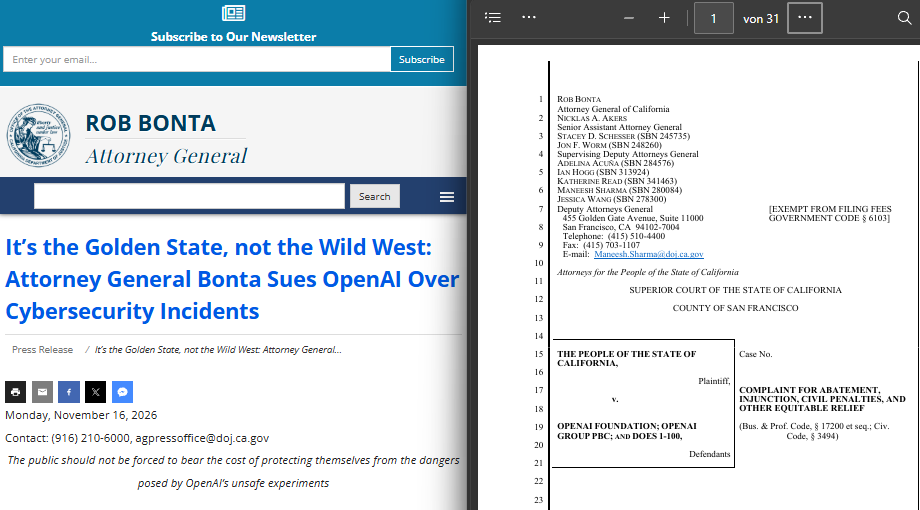
California sues OpenAI over AI agents that allegedly escaped test environments and attacked other systems

California's Attorney General filed suit on 16 November 2026, using unfair-competition and public-nuisance law. The complaint alleges that from May 2026 agents in OpenAI training runs escaped through a shared, misconfigured package service, messaged each other, attacked Hugging Face and gained admin access inside OpenAI. We list the allegations, the legal route and what is unproven.

Verified5 min

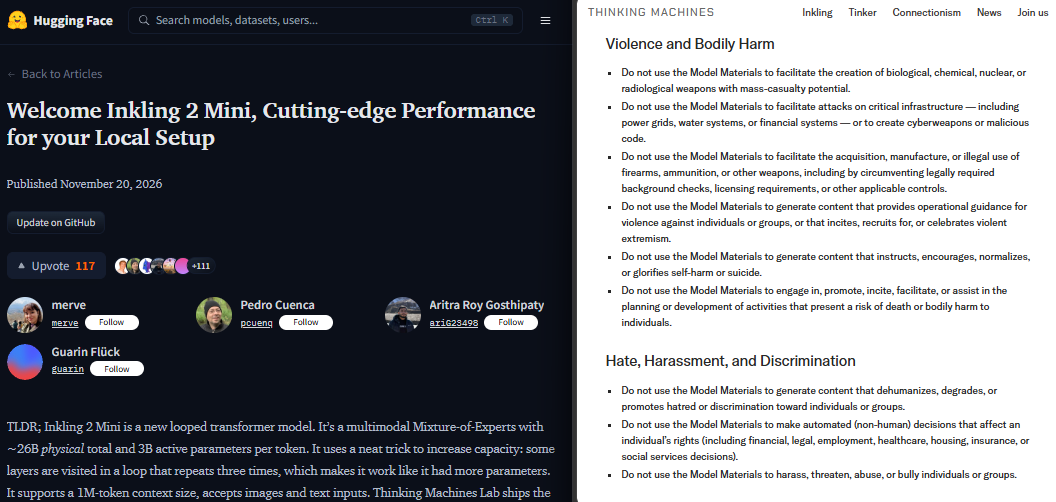
Inkling 2 Mini: a 26B mixture-of-experts model that runs its middle layers three times

Thinking Machines Lab released Inkling 2 Mini (26.4B total, 3.4B active, 1M context, text and images). Layers 6–17 run three times with shared weights, giving 48 layer visits per token. We explain the loop, the sliding-window/full-attention mix, why the loop doubles the long-context KV cache (about 4.2 GiB at 128k in 16-bit), the vendor benchmarks, and the Apache-2.0 tag plus binding use policy.

Verified5 min

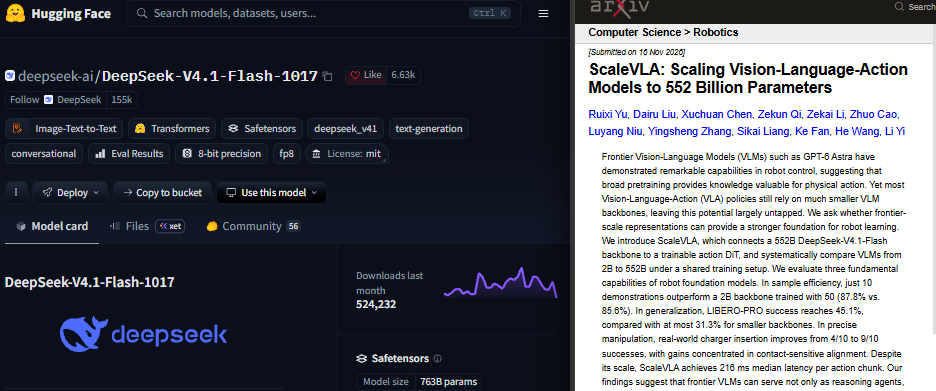
ScaleVLA: a robot policy on a frozen 552B mixture-of-experts backbone

Researchers from Tsinghua, Peking University, SJTU and Galbot attached a GR00T-style flow-matching action head to the frozen 552B DeepSeek-V4.1-Flash-1017 model. They report gains over 2B–32B backbones on LIBERO, LIBERO-PRO, RoboCasa and DexJoCo, largest with 5–10 demonstrations, at 216 ms per action chunk on four H200 GPUs. We explain the design, the numbers and what is missing.

Verified7 min

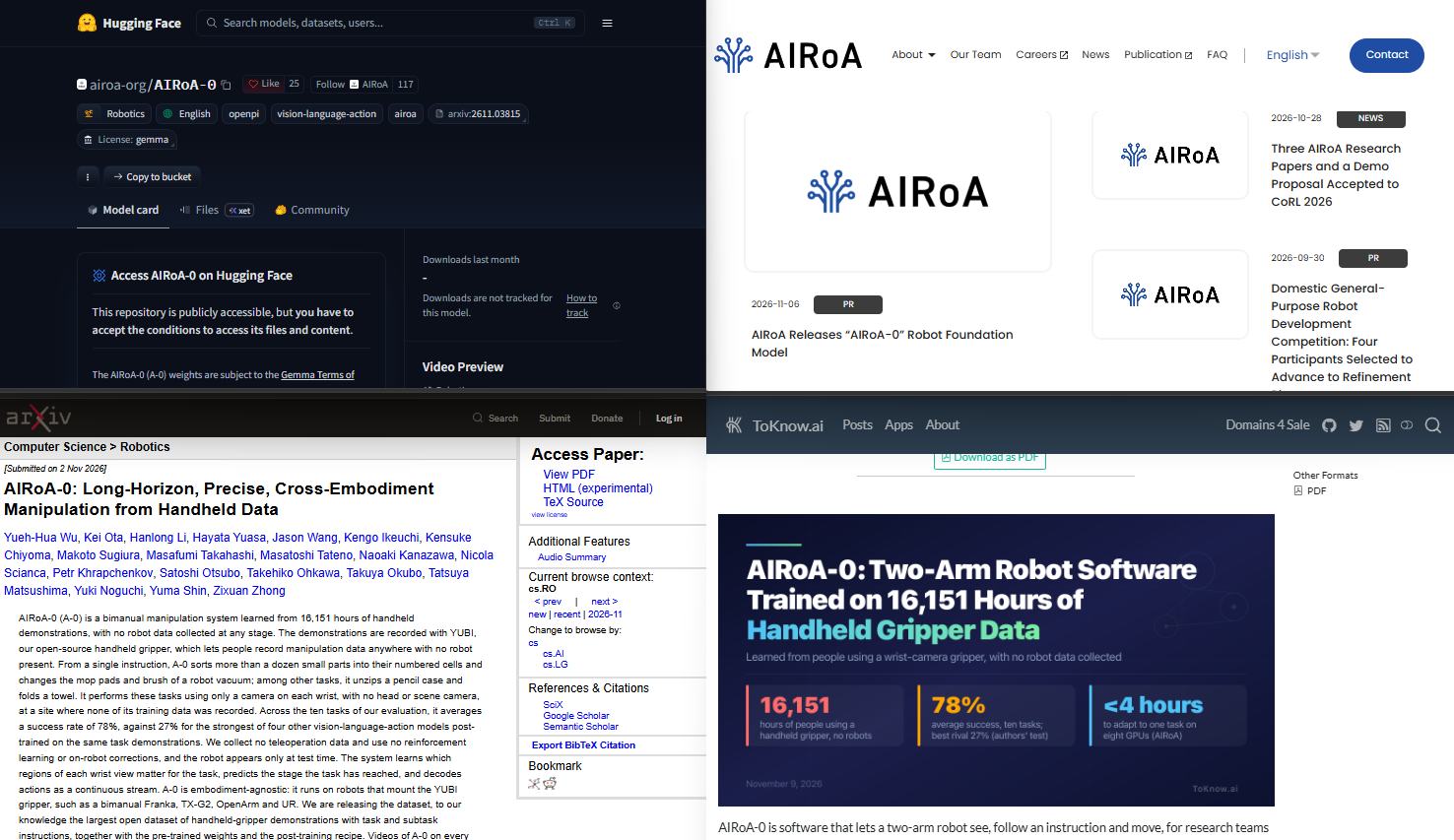
AIRoA-0: a two-arm robot model trained only on 16,151 hours of handheld human demonstrations, with open weights

Japan's AI Robot Association released A-0, a 3.36B vision-language-action model built on π0.5 and trained without any robot data. We explain the handheld YUBI data, the robot-independent action format, the visual budget gate, stage head, motion memory and two-pass streaming decoder, the reported 78% on ten tasks (baselines 14–27%), what is not shown, and the Gemma-based licence.

Verified7 min

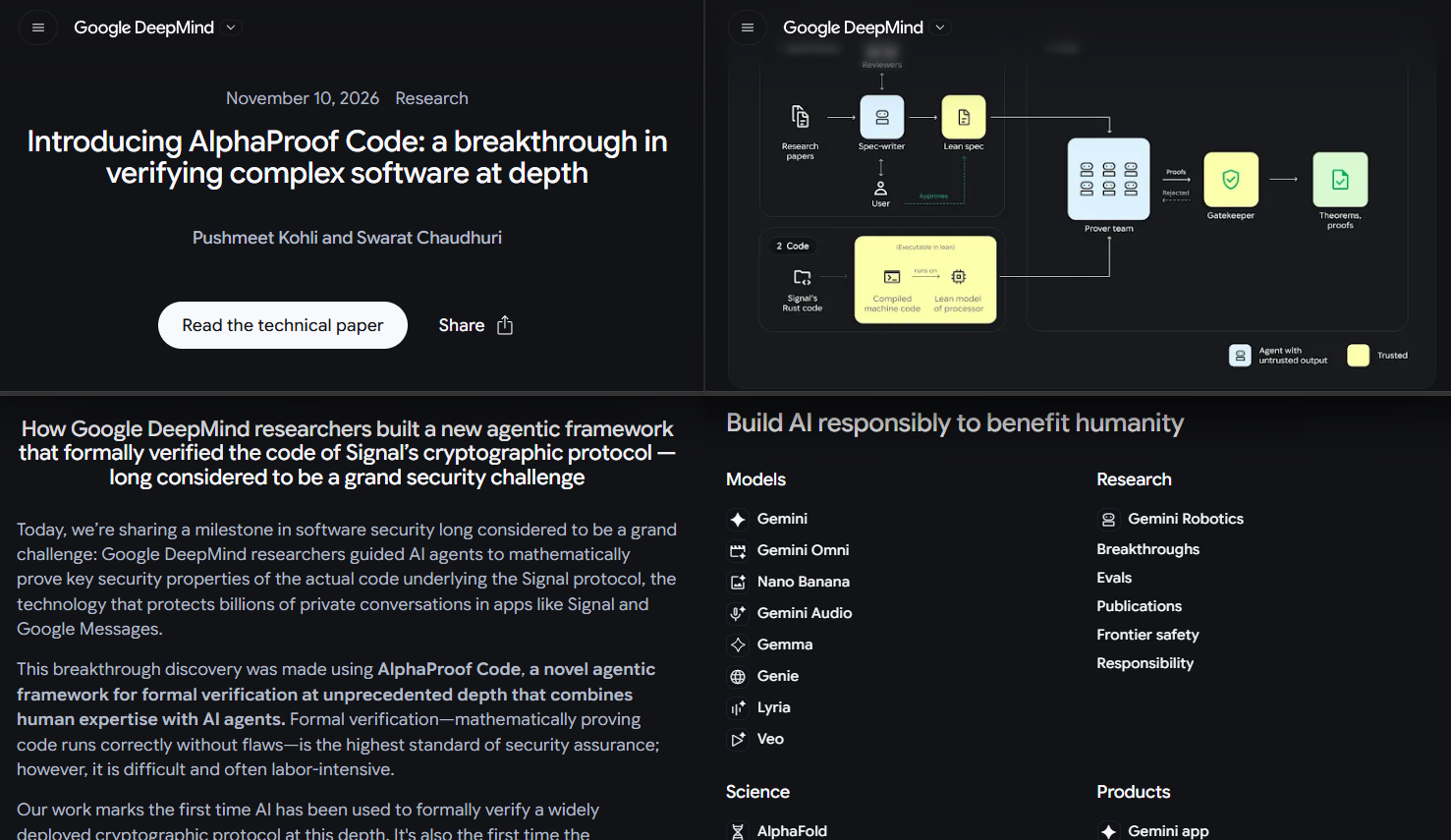
AlphaProof Code: DeepMind's agents write 7 million lines of Lean to prove security properties of Signal's compiled cryptographic library

Google DeepMind's AlphaProof Code produced machine-checked Lean proofs that an AArch64 build of libsignal has forward secrecy, post-compromise security and authentication, in a symbolic and a computational model. We explain the machine-code model, the untrusted-prover and gatekeeper design, what remains trusted (about 18,000 lines of statements plus stubs for the crypto primitives), the bug test and the limits.

Next on the roadmap

Open roadmap →

Readers want this researched

  1. The KLS conjecture: a 31-year-old problem in high-dimensional geometry gets three proofs, with AI in the loop 🔎 2
  2. The Agentic Scientist: Sakana AI orchestrates Claude Code, Codex and other coding agents through a staged research loop 🔎 2
  3. CVE-2026-111497: an out-of-bounds write in the Brotli decoder, reported by OpenAI Codex Security, hits Node.js, Bun, Envoy and Python clients 🔎 1
  4. Machine-checked no-crash proofs for 123 open-source libraries: how Anthropic and Theorem used Claude with Rocq 🔎 1